

京都府の2026年3月実施の令和8年度(2026年度)入学者の公立高校入試問題の解説をしています。
受験勉強において、過去問を解くことはとても効果的な勉強法です。ぜひ、受験までに一度挑戦し、問題の傾向を掴んでおきましょう。合わせて、対策などをたてられるととても良いですね。
また、過去問で苦手な点が見つかった場合は、そこを中心に試験日当日までにしっかりと対策しておきましょう。
次の英文は,高校2年生の美夕(Miyu)が英語の授業で書いた作文である。これを読んで,問い(1)~(8)に答えよ。
I have a friend ①(call) Beth. She came from *Canada in May, and spent one month as a student in our school. One Friday, I asked her, “What do you do in Canada on holidays?” She said, “I sometimes visit the mountains and parks to enjoy *camping with my family. I like seeing *stars at night in those places. Oh, I have some pictures which can help you learn about my life in Canada.” Then, she showed them to me and said, “I took these pictures in *spots for seeing stars. Canada has many *stargazing spots. They are *dark at night, so it’s easy to see stars in the *night sky.” I said, “These stars are amazing! I want to visit the stargazing spots in Canada to see these stars someday. I’ve never been to Canada.” Beth said, “You should do that.”
I became interested in stargazing spots in Canada, so ②I visited my aunt on Saturday to ask her about them. She likes taking pictures and often travels to foreign countries alone. She told me Canada has a *system to *maintain stargazing spots. Then, she said, “Each area gives people living there and tourists the place and time to learn about stargazing spots and ways to maintain them. Most of the spots are in the mountains or big parks. In one of the spots near a city, people try to *turn off the lights of their houses when they know they can see stars on that day.”
After I listened to my aunt, I said to her, “I didn’t know there are so many beautiful stargazing spots and a system to maintain them in Canada. By the way, are there any famous stargazing spots in Japan, too?” She said, “Yes. How about [ ③ ]?” I said, “I’ll do that. Then, why don’t we visit one of them?” She agreed with me. I began to collect information on the Internet and by reading books.
The next Friday, I told my aunt about some stargazing spots in Japan. We decided to visit one of the spots during summer vacation. We made a plan to visit it with a *guide at night and see stars there.
One day during summer vacation, we visited a small island. To visit a stargazing spot, we met a guide at eight p.m., and decided to go to a river by car. In his car, he said to us, “Japan has some famous stargazing spots and a system to maintain them. For example, look at the lights on this street. Six years ago, to see stars easily, people began to use a different kind of light to keep this area dark.”
Thirty minutes later, we ④(leave) the car, and walked near the river. I found the area around us was dark and only the stars were *bright. Then, my aunt said, “We can see so many stars. I don’t ⑤[ (ア) are / (イ) how / (ウ) there / (エ) stars / (オ) know / (カ) many ] in the sky.” I said, “You’re right. They are amazing.” I was surprised to see the *magnificent *view of many stars in the night sky with my own *eyes. The stars I saw there were more beautiful for me than the stars in pictures. The guide said, “I’m glad you enjoy this view. When I learned about a system to maintain this spot, I realized one thing. To continue seeing this kind of view, it’s important for many people to understand what to do and take action. On this island, some people like me work as a guide to tell people living here and tourists about this beautiful night sky and the system to maintain it. Also, some people visit schools every year to tell children about stars. I have lived on this island since I was a child. In the future, I want children on this island to continue enjoying seeing stars and work with us to maintain the beautiful night sky.” I said to the guide, “Local people like you are working to help people think about ways to maintain this magnificent view. I didn’t know ⑥that.”
Since I talked with Beth about stargazing spots, I’ve learned two things. First, by visiting the local area, seeing something with our own eyes, and meeting local people, we can get a unique experience. Through my unique experience, I learned the second thing. To maintain the good points an area has, it’s important to try to do something with many people around us like that guide.
(注)Canada カナダ camping キャンプ star 星 spot 地点 stargazing 星の観察 dark 暗い night sky 夜空 system 制度 maintain ~ ~を維持する turn off ~ ~を消す guide ガイド,案内人 bright 明るい magnificent 壮大な view 景色 eye 目
下線部①(call)・④(leave)を,文意から考えて,それぞれ正しい形にかえて1語で書け。
次の英文は,下線部②について説明したものである。これを読んで,下の問い(a)・(b)に答えよ。
Miyu visited her aunt to learn about stargazing spots in Canada because her aunt often [ i ] to other countries alone. Then, Miyu learned some things from her aunt. First, there is a system to maintain stargazing spots in Canada. Also, each area has the place and time that local people and tourists can use when they want to learn about stargazing spots and [ ii ].
(a) 本文の内容から考えて,[ i ] に入る最も適当な語を,本文中から1語で抜き出して書け。
(b) 本文の内容から考えて,[ ii ] に入る表現として最も適当なものを,次の(ア)~(エ)から1つ選べ。
(ア) what makes seeing stars popular
(イ) how to maintain them
(ウ) people trying to maintain them
(エ) who knows about the system
[ ③ ] に入る表現として最も適当なものを,次の(ア)~(エ)から1つ選べ。
(ア) going to one of them instead of me
(イ) visiting one of them before you look for its information
(ウ) taking pictures in one of the spots in Canada
(エ) looking for the information about them
下線部⑤の [ ] 内の(ア)~(カ)を,文意が通じるように正しく並べかえ,記号で書け。
下線部⑥が指す内容として最も適当なものを,次の(ア)~(エ)から1つ選べ。
(ア) People who liked the guide were trying to think about ways to maintain the view.
(イ) People who visited the island as a trip were working to maintain the view.
(ウ) Local people were taking action and wanted other people to maintain the view together.
(エ) Local people felt happy to know that the guide was working to maintain the view.
本文の内容から考えて,次の〈質問〉に対する答えとして最も適当なものを,下の(ア)~(エ)から1つ選べ。
〈質問〉 What did the guide find by learning about a system to maintain a stargazing spot of the island?
(ア) He found that many people should realize what to do and should do it to continue seeing the view.
(イ) He found that people don’t have to worry about maintaining it because the system can go well.
(ウ) He found that many people should know that a guide feels glad when people enjoy the view.
(エ) He found that people who had the experience of learning about the system should become a guide.
本文の内容と一致する英文として最も適当なものを,次の(ア)~(エ)から1つ選べ。
(ア) Beth showed Miyu the pictures taken by Beth’s family in Canada to tell Miyu about Beth’s life.
(イ) If people in a spot near a city know they can see stars, they make the lights of their houses bright.
(ウ) Miyu found a different kind of light people used on the island and told the guide the light’s history.
(エ) The stars seen in pictures were not as beautiful for Miyu as the stars seen on the island.
次の英文は,この作文(essay)を読んだ高校生の葉月(Natsuki)と留学生のマックス(Max)が交わしている会話の一部である。これを読んで,下の問い(a)・(b)に答えよ。
Max: I read Miyu’s essay, and now I want to see a magnificent view in a stargazing spot someday. She explains how she felt when she saw a view like that on an island with [ i ].
Natsuki: I see. She tells us that seeing things with ours is one of the things to get a unique experience. She also tells us about visiting the local area and meeting the people there to get such an experience.
Max: Actually, I think I got such experiences after I came to Japan.
Natsuki: Wonderful. I want to go to other countries someday. She also tells us another thing she learned through her experience. According to her, if [ ii ] work together with us when we try to do things, we can maintain the good points of an area.
Max: I see. Now I want to think about the ways to maintain the good points my city has.
(a) 本文の内容から考えて,[ i ] に入る最も適当なものを,次の(ア)~(エ)から1つ選べ。
(ア) her own books
(イ) her own eyes
(ウ) people
(エ) pictures
(b) 本文の内容から考えて,[ ii ] に入る表現として最も適当な部分を,本文中から4語で抜き出して書け。
➀呼ばれるという受け身の形になるので、過去分詞にします。
③文中の時制(過去形)にします。
(a)本文中と照らし合わせて解きます。
本文:She likes taking pictures and often travels to foreign countries alone.
設問:her aunt often [ i ] to other countries alone.
(b)同じく、本文中と照らし合わせて解きます。
本文:to learn about stargazing spots and ways to maintain them.
設問:to learn about stargazing spots and [ ii ].
waysは方法という意味なので、how toが使われているイが正解です。
この後に”why don’t we visit one of them?”「それら(星の観察ができる場所)に一緒に行かない?」と誘っているので、「情報を調べること」となるエが正解です。
文法問題です。間接疑問文を作ります。
間接疑問文の語順は主語とbe動詞がひっくり返らないので注意です。
本文中直前のLocal people like you are working to help people think about ways to maintain this magnificent view.が答えになります。
指示語問題は必ず直前に答えが隠れています。
本文中To continue seeing this kind of view, it’s important for many people to understand what to do and take action.が答えになります。
アはBethの家族が取った写真とは言っていないので不適です。
イは光を輝かせようとしちゃってるので不適です。
ウは島の歴史を聞いてるときに発見したのではなく、ガイドが教えてくれたので不適です。
(a)最終段落の本文中と照らし合わせます。
本文中:seeing something with our own eyes
設問:saw a view like that on an island with [ i ]
(b)こちらも同じく、最終段落の本文中と照らし合わせます。
本文中:it’s important to try to do something with many people around us like that guide.
設問:if [ ii ] work together with us when we try to do things
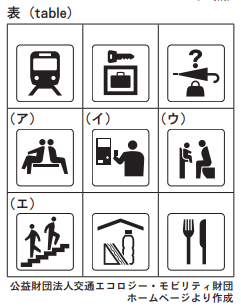
次の英文は,高校生の耕平(Kohei)と留学生のテッド(Ted)が,案内用図記号であるピクトグラム(pictogram)について交わしている会話である。次の表(table)を参考にして英文を読み,下の問い(1)~(4)に答えよ。
Ted : Hi, Kohei. Last Sunday I went to Minato Station by bus and tried to take a train there. But the station was very big, so I was not sure where to go to take a train.
Kohei: I see. [ ① ]?
Ted : I tried to do so, but it was difficult because the people walking around me looked very busy. But actually, pictograms helped me. By looking at the pictograms, I was able to take a train.
Kohei: Pictograms? What are they?
Ted : Pictograms are *simple pictures which give us information. Well, look at this table of nine pictograms on a website. This pictogram is the one which I used to take a train.
Kohei: Oh, it’s easy to understand what this pictogram means. I think pictograms can help people from different countries like you when they don’t understand Japanese.
Ted : I think so, too. It’s also easy for children to understand pictograms. Look at these two pictograms. Each one of them has something like a bag. Do you understand their meanings?
Kohei: In one pictogram, I can see a bag in a box and a key. I think we can keep something safe in the box. In the other pictogram, I can see a bag, an *umbrella and a *question mark. At the place this pictogram shows, can we ask questions about bags and umbrellas?
Ted : That’s an interesting idea, but bags and umbrellas are just examples of the things people often lose on a bus or a train. If they lose something, they can try to find it at the place this pictogram shows.
Kohei: I understand what kind of place it is. I have seen a place like that in a big station.
Ted : Yes. Big stations often have such a place. Now, look at ②this pictogram. Do you understand it?
Kohei: Well, there are two people in the pictogram. They are sitting on a chair or something. One person looks bigger than the other one. I think a parent and a little child can sit at the place.
Ted : Right. So if a parent wants to let a *baby sit on a chair, the parent should look for this pictogram. They can stay in one room at the [ ③ ] time, so they will feel safe. Next, how about this one?
Kohei: Well, in the pictogram, I can see two things that we use when we eat something. I think if we go to the place this pictogram shows, we can eat food. Does it show a restaurant?
Ted : That’s right. Next, look at this pictogram. What can you see in it?
Kohei: I can see something to eat and drink. But we have just looked at the pictogram showing a restaurant, so this pictogram doesn’t show the [ ④ ] place. It is a different place.
Ted : Well, it shows a kind of store that we sometimes visit to buy some food or drink.
Kohei: Oh, I see. Does it show a *convenience store?
Ted : Yes. Like these examples, pictograms are useful for many people.
(注)simple 単純な umbrella 傘 question mark 疑問符 baby 赤ちゃん convenience store コンビニエンスストア
[ ① ] に入る表現として最も適当なものを,次の(ア)~(エ)から1つ選べ。
(ア) Did you ask anyone about it
(イ) Did you take a bus there
(ウ) Did you help anyone there
(エ) Did you go to the station by train
本文と表(table)の内容から考えて,下線部②にあたるものとして最も適当なものを,表(table)中の(ア)~(エ)から1つ選べ。
[ ③ ] ・ [ ④ ] に共通して入る最も適当な1語を書け。
本文と表(table)の内容と一致する英文として最も適当なものを,次の(ア)~(エ)から1つ選べ。
(ア) Ted looked at the pictograms at Minato Station last Sunday, but he couldn’t take a train.
(イ) Kohei and Ted think pictograms are useful for foreign people who don’t understand Japanese.
(ウ) Kohei has never seen a place that people visit if they lose something on a bus or a train.
(エ) Two things that people use to eat food are seen in the pictogram showing a convenience store.
直後のTedの返答が「そうしようとしたけれど、周りの人が忙しそうに見えて難しかった(I tried to do so, but it was difficult…)」となっているため、耕平が「誰かに尋ねてみましたか?」と促したと考えるのが適当です。
下線部②について、耕平は「ピクトグラムに2人いて、椅子か何かに座っている。片方が大きく見えるから親と小さな子が座れる場所だと思う」と述べています。これに合致するのは、表の(ア)(ベンチに座る親子のピクトグラム)です。
[ ③ ] : 「彼らはひとつの部屋に【同じ(same)】時間に滞在できるので安心する(at the same time)」となります。
[ ④ ] : 耕平がレストラン(食事する場所)とコンビニを混同した際、耕平が「レストランを示した直後だから、このピクトグラムは【同じ(same)】場所を表していない(doesn’t show the same place)」と述べる文脈になります。
(ア)×: Tedはピクトグラムを見て無事に電車に乗ることができました(was able to take a train)。
(ウ)×: 耕平は遺失物取扱所のような場所を「大きな駅で見たことがある(I have seen a place like that…)」と述べています。
(エ)×: 食事の道具(ナイフとフォーク)が描かれているのはレストランのピクトグラムです。
それぞれの質問に対する答えとして最も適当なものを,次の(ア)~(エ)から1つずつ選べ。
(ア) One book.
(イ) Two books.
(ウ) Three books.
(エ) Five books.
(ア) She will ask what time other members can play volleyball next Sunday.
(イ) She will ask Mika’s sister what time they will go shopping in the afternoon next Sunday.
(ウ) She will ask other members to look for a member who can play volleyball next Sunday.
(エ) She will ask other members to play volleyball together in the afternoon next Sunday.
数がたくさん出てくるので惑わされないように。
マイが先月読んだ本の数は3冊。いつもは5冊読む。クミは先月2冊読んだと放送されています。
質問はマイが先月読んだ本の数を聞かれているのでウが正解です。
ミカをバレーボールに誘いますが、ミカは午後に姉と買い物に行く予定があるようです。するとエミリーは他のメンバーに早くできるか聞いてみるよと伝えています。ミカは朝になると嬉しいと言っています。
質問はエミリーが次にすることは?と聞いているのでアが正解です。
それぞれの質問に対する答えとして最も適当なものを,次の(ア)~(エ)から1つずつ選べ。
(ア) 地図に載っているすべての店を訪れ,店の名前を地図に記入する。
(イ) 地図に載っているすべての店を訪れ,カードを集める。
(ウ) 地図に載っている店のうち,どの店が一番好きかを選ぶ。
(エ) 地図に載っている店のうち,どの店のスタッフが一番親切かを選ぶ。
(ア) いくつかのレストランで支払いに使えるチケット
(イ) クッキー
(ウ) 次回のイベントに参加するために必要なチケット
(エ) コーヒー
ミユはマップにある店舗を訪れてカードを集めたと言っています。すべての店を回ると、クッキーやコーヒーがもらえ、一番大きな商品はレストランのお金の代わりになるそうです。
ルーシーは三番目(レストランのお金の代わり)がいいと言っていますが、ミユは弟がコーヒーが好きなので2番目(コーヒー)をもらったようです。
イベントで何をしないといけないか聞かれているので、イが正解です。
ミユが何を選んだかを聞かれているのでエが正解です。
それぞれの会話のチャイム音のところに入る表現として最も適当なものを,下の(ア)~(エ)から1つずつ選べ。
(ア) I’ll do so before I start writing my report today.
(イ) Sure, I’ll show it to you.
(ウ) Sounds interesting. I’ve never tried such a way.
(エ) Writing a report with it was difficult.
(ア) I agree. You can arrive at the museum earlier by that bus.
(イ) That’s nice. I hope you will have a good day in the museum.
(ウ) I see. If there were a bus to the museum, we could go there easily.
(エ) Well, you can go to Midori Station by train, and then, walk for twenty minutes.
音楽の授業のレポートを書いていて、コンピューターを用いて書く曲についてのレポートを書いたことへの返答なので、ウが正解です。
バスにあまり乗ったことがないから他の方法はない?と聞かれたことへの返答なので、エが正解です。
家庭教師のやる気アシストは、大阪府にお住まいの受験生のお子さんを毎年たくさん指導をさせ頂き、合格に導いています。
高い合格率の秘訣は、指導経験豊富な先生の指導力に加え、1対1の指導でお子さん一人ひとりの状況に合わせた、お子さんだけのカリキュラムで勉強が進められるから!
家庭教師のやる気アシストは、お子さんの志望校合格まで全力でサポートさせて頂きます!
LINE問合せ窓口
LINEからもお問合せいただけます!

公式Instagram
勉強のお役立ち情報を配信中!
お問い合わせ、ご質問も受付中です!

ご質問などお気軽にお問い合わせください。
お子さんにとって「成果が出る勉強法」ってどんな勉強法だと思いますか?
お子さんそれぞれに、個性や性格、学力の差もあります。そんな十人十色のお子さん全員に合う勉強法ってなかなかないんです。
たからこそ、受験生の今だけでもお子さんだけの勉強法で受験を乗り越えてみませんか?
やる気アシストには、決まったカリキュラムはありません。お子さんの希望や学力、得意や不得意に合わせて、お子さんだけのカリキュラムで指導を行っていきます。また、勉強法もお子さんそれぞれに合う合わないがあります。無料体験授業では、お子さんの性格や生活スタイルを見せていただき、お子さんにとって効率的な成果の出る勉強のやり方をご提案させて頂きます。