
大阪府の2026年3月実施の令和8年度(2026年度)入学者の公立高校入試問題の解説をしています。
受験勉強において、過去問を解くことはとても効果的な勉強法です。ぜひ、受験までに一度挑戦し、問題の傾向を掴んでおきましょう。合わせて、対策などをたてられるととても良いですね。
また、過去問で苦手な点が見つかった場合は、そこを中心に試験日当日までにしっかりと対策しておきましょう。
大阪府の英語の問題は、難易度としては全体的に高く、Aがやや易、Bが難、Cが激難といったところです。
Cに至っては大学入試に近いような印象さえ受けます。設問もオールイングリッシュで書かれています。
大阪府の公立高校入試情報はこちら
大阪府で家庭教師を考えている方はこちら
(A・B共通)【話し方・聞き方(リスニング)】
1.カナとティムとの会話を聞いて、ティムのことばに続くと考えられるカナのことばとして、次のア~エのうち最も適しているものを 1 つ選び、解答欄の記号を○で囲みなさい。
Kana: Tim, I will watch a rugby game with my friends. Can you join us?
Tim: Sure, Kana. What time will the game start?
ア. At 2 p.m.
イ. On the bus.
ウ. Last summer.
エ. No, thank you.
2.カナとティムとの会話を聞いて、ティムが着ているTシャツのデザインとして、次のア~エのうち最も適していると考えられるものを 1 つ選び、解答欄の記号を○で囲みなさい。
Kana: Tim, I like your T-shirt. It’s nice.
Tim: Thank you, Kana. It has a picture of my favorite animal.
Kana: Oh, you like dolphins.
Tim: Yes. I like this design of a dolphin and sea waves.

3.鈴木先生が英語の授業で生徒に話をしています。鈴木先生の話のテーマとして、次のア~エのうち最も適していると考えられるものを 1 つ選び、解答欄の記号を○で囲みなさい。
What do you do in your free time? I often enjoy outdoor activities. I especially enjoy climbing mountains. Climbing mountains is not easy exercise. But, when I reach the top of a mountain and see a great view of the nature, I feel great joy. It’s also fun to talk with people I meet while I climb a mountain.
ア.Famous places in Japan.
イ.The activity Ms. Suzuki enjoys.
ウ. The best season for climbing mountains.
エ. Various outdoor sports.
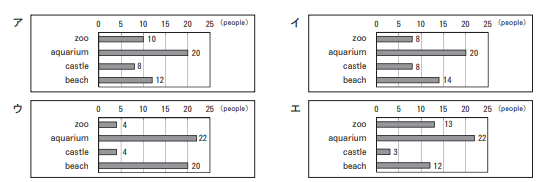
4.カナとティムとの会話を聞いて、ティムの作成したレポートの情報として、次のア~エのうち最も適しているものを 1 つ選び、解答欄の記号を○で囲みなさい。
Kana:Tim, I heard you did a survey for the next school English newspaper.
Tim:That’s right, Kana. I asked a question to 50 students. The question was “Of the four popular places in this city, which do you like the best?” I have made a report of the results.
Kana:Sounds interesting. Please tell me more.
Tim:The students chose one place from the zoo, the aquarium, the castle and the beach.
Kana:I guess the aquarium was the most popular.
Tim:You’re right! 20 students chose it.
Kana:I see. And what was the second?
Tim:Well, it was the beach. And both the zoo and the castle were the third. Each of them was chosen by eight students.
5.グリーン先生が英語の授業で生徒に話をしています。その話を聞いて、それに続く 2 つの質問に対する答えとして最も適しているものをそれぞれア~エから 1 つずつ選び、解答欄の記号を○で囲みなさい。
Hello, class. Today, I’ll talk about the thing I like. It’s dancing. I started dancing when I was a high school student in the U.S. One day, I saw a performance of professional dancers. Their performance was amazing and made me excited. The dancers also looked very happy about their performance. I wanted to learn dancing then.
A few days later, I went to a local dance school to see its lesson. I saw about ten people dancing there. Though they were not professional dancers, their dance was very good. I thought I couldn’t dance like them. I was worried and didn’t join the dance school on the day.
The next day, I had a chance to talk with my aunt. I told her how I felt at the dance school. She then said, “I understand how you felt. But nobody is good at something from the beginning. If you keep trying it, you can get better someday.” Her words gave me courage and I joined the dance school.
I have enjoyed dancing since then. Now, I enjoy dancing in Japan. I don’t speak Japanese well, but through dancing, I made many friends here. I want you to remember that we are all beginners when we start something new. Don’t be afraid of trying a new thing!
Question 1: How did Mr. Green feel when he saw the professional dance performance?
Question 2: What is the thing Mr. Green said?
(1)
ア. Excited.
イ. Lonely
ウ. Peaceful.
エ. Worried.
(2)
ア. He started dancing when he became a high school teacher.
イ. He joined a local dance school without seeing its lesson.
ウ. He was encouraged by his auntʼs words and joined a local dance school.
エ. He didnʼt continue dancing and started something new in Japan.
6.カナとティムとの会話を聞いて、それに続く 2 つの質問に対する答えとして最も適しているものをそれぞれア~エから 1 つずつ選び、解答欄の記号を○で囲みなさい。
Kana:Tim, you look happy.
Tim:Hi, Kana. My grandparents will come to Japan next month. They will travel to Osaka and Kyoto.
Kana:That’s great. So, you will see them, right?
Tim:Sure. My host family and I will pick them up at the airport in Osaka and then we’ll have a party at home to welcome them. That will be my first time to see my grandparents after I started to live in Japan.
Kana:That’s nice. Will they come to Japan for the first time?
Tim:No, they have been to Tokyo once. They will visit Osaka and Kyoto for the first time.
Kana:I see. Will you guide them during their trip?
Tim:I’ll show them around Osaka for one day. I don’t think I’ll go to Kyoto with them. They have a friend living in Kyoto and they will stay at her house. She will take them to some temples they want to visit in Kyoto.
Kana:I see. Where will you take them in Osaka?
Tim:I haven’t decided yet. My grandparents say they want to visit places I often visit.
Kana:They may want to know about your life in Japan.
Tim:Maybe. Oh, if you are interested, would you like to join us? I’ll show them around Osaka on the first Sunday next month.
Kana:I’ll be free on that day. I’ll join you. I want to show your grandparents many interesting places in Osaka.
Tim:Let’s make a plan together!
Kana:OK!
Question 1: Who will take Tim’s grandparents to some temples in Kyoto?
Question 2: Which is true about this conversation?
(1)
ア. Tim.
イ. Timʼs host family.
ウ. A friend of Timʼs grandparents.
エ. Timʼs friends living in Kyoto.
(2)
ア. Timʼs host family will first see his grandparents at a party at home.
イ. Timʼs grandparents will come to Japan for the first time.
ウ. Tim will take his grandparents to places his host family recommended.
エ. Tim and Kana will guide Timʼs grandparents around Osaka.
1 次の(1)〜(10)の日本語の文の内容に合うように、英文中の( )内のア〜ウの中から最も適しているものを一つずつ選び、記号を〇で囲みなさい。
(1) 昨日、私は公園に行きました。
I went to a ( ア hospital イ museum ウ park ) yesterday.
(2) 私の姉は朝に本を読みます。
My sister reads a book in the ( ア afternoon イ evening ウ morning ).
(3) あの犬はかわいいです。
That dog is ( ア cute イ famous ウ large ).
(4) 一緒に歌いましょう。
Let’s ( ア cook イ sing ウ swim ) together.
(5) 私はこれをテーブルの下で見つけました。
I found this ( ア between イ on ウ under ) the table.
(6) これらは彼女の本です。
These ( ア am イ are ウ is ) her books.
(7) あなたは彼を知っていますか。
Do you know ( ア he イ him ウ his )?
(8) これは部屋を掃除するための新しい機械です。
This is a new machine ( ア clean イ cleaned ウ to clean ) the room.
(9) 旅行の間、私はたくさんのすてきな写真をとることができました。
During my trip, I could( ア take イ taken ウ took ) a lot of nice photos.
(10) あなたはこれまでに富士山に登ったことがありますか。
Have you ever ( ア climb イ climbed ウ climbing ) Mt. Fuji?
(1) ウ
hospital→病院、 museum→博物館
(2) ウ
afternoon→午後、 evening→夕方、夜
(3) ア
famous→有名な、 large→大きい
(4) イ
cook→料理する、 swim→泳ぐ
(5) ウ
前置詞を選ぶ問題。
between→ ~の間で [に]
on→ ~に接して、~の上に
under→ ~の下で [に]
(6) イ
適切なbe動詞を選ぶ問題。
am→ 「I」のbe動詞
are→「You」「They」や複数形のbe動詞
is→ 「He」「She」や単数形のbe動詞
(7) イ
he→ 主格。「彼が」「彼は」
him→ 目的格。「彼を」「彼に」
his→ 所有格。「彼の」
(8) ウ
~するために→【to + 動詞の原形】
(9) ア
助動詞の後ろに来る動詞は原形。
(10) イ
「have + 過去分詞」で現在完了を表す。
2 アキラ (Akira) は日本の高校生です。次の[Ⅰ][Ⅱ]に答えなさい。
【Ⅰ】次は、アキラが英語の授業で行ったスピーチの原稿です。彼が書いた原稿を読んで、あとの問いに答えなさい。
Hello, everyone. Do you sometimes eat kamaboko? Kamaboko is a Japanese food made from fish. I’m going to [ ① ] you some interesting information about kamaboko.
Long ago, people in Japan started making kamaboko. When people got many fish, they hoped to eat some of them later. However, in old times, keeping fish fresh for a long time was difficult. So, people thought about some ways to preserve fish for a long time. One of the [ ② ] was making kamaboko. People made fish into paste and baked it. By doing so, some water in the fish was removed. Preserving food is easier if water in it is removed. Making kamaboko was good way to preserve fish.
To make kamaboko, people in various areas used fish which Ⓐthey got nearby. Kamaboko in various areas often tasted different. Also, different shapes of kamaboko were created. Now, we can find many kinds of kamaboko around Japan.
Many foods have their own unique history. If you do research on your favorite food, you may find something interesting!
(注)preserve 保存する paste すりつぶしたもの
(1) 次のうち,本文中の [ ① ] に入れるのに最も適しているものはどれですか。1つ選び、記号を〇で囲みなさい。
ア. tell
イ. tells
ウ. told
エ. telling
(2) 本文の内容から考えて、次のうち、本文中の [ ② ] に入れるのに最も適しているものはどれですか。1つ選び、記号を○で囲みなさい。
ア. fish
イ. foods
ウ. foods
エ. ways
(3) 本文中の Ⓐthey の表している内容に当たるものとして最も適しているひとつづきの英語4語を、本文中から抜き出して書きなさい。
(4) 次のうち,本文で述べられている内容と合うものはどれですか。一つ選び、記号を〇で囲みなさい。
ア. アキラは、かまぼこの生産量が年々減っていると話した。
イ. アキラは、かまぼこのおいしい食べ方について説明した。
ウ. アキラは、昔人々がかまぼこを作ろうとした理由を説明した。
エ. アキラは、自分でかまぼこを作ったときの経験について話した。
[Ⅱ]スピーチの後に、あなた(You)がアキラと次のような会話をするとします。あなたならば、どのような話をしますか。あとの条件1~3にしたがって(①)〜(③)に入る内容を,それぞれ5語程度の英語で書きなさい。解答の際には記入例にならって書くこと。
You:Akira, I enjoyed learning about kamaboko.( ① )It’s delicious.
Akira:Oh, I’m happy to hear that.
You:( ② )How did you find the information about kamaboko ?
Akira:I read some books about it.
You:( ③ )
Akira:Yes, I will bring them tomorrow.
〈条件1〉①に、「私はそれがとても好きです。」と伝える文を書くこと。
〈条件2〉② に、「私はもっと知りたいです。」と伝える文を書くこと。
〈条件3〉③ に、前後のやり取りに合う内容を書くこと。
[Ⅰ]
(1) ア
「be going to + 動詞の原形」
→「~するつもりだ」
(2) エ
One of the [ ② ] was making kamaboko.(【和訳】かまぼこをつくる ② のうちの1つ)
→よって ways(方法)が適切。
(3) people in various areas
which節によって、fishを後ろから修飾している。ここではさまざまな地域の人々がそれぞれ近くで取れる魚を使用してかまぼこを作るという内容がかかれているので、正解は people in various areas である。
(4) ウ
[Ⅱ]
①(例)I like it very much.
②(例)I want to know more.
③(例)Can I read the books?
次は、高校生のケイコ (Keiko)、イタリアからの留学生のソフィア(Sofia)、クラスメートのサトシ(Satoshi)の3人が昼休みに学校で交わした会話の一部です。会話文を読んで、あとの問いに答えなさい。
Sofia: Keiko, I finished the water in my bottle. I need to drink more water.
Keiko: You can use the drinking fountain, Sofia.
Sofia: Oh, that’s nice. [ ① ] is it?
Keiko: It’s in front of the gym. I will take you there.
Sofia: Thank you, Keiko.
Satoshi: Hi, Keiko and Sofia. What [ ② ] ?
Keiko: Hi, Satoshi. We are talking about the drinking fountain in front of the gym. Now, I will take Sofia there. She will drink some water.
Satoshi: I will [ ③ ] , too. I will go with you.
Keiko: Sure.
The three students walked to the gym, and stopped in front of it.
Keiko: Here’s the drinking fountain.
Sofia: Thank you, Keiko.
Keiko: I often use this drinking fountain. Do you often use it, Satoshi?
Satoshi: [ ④ ] I use it very often because I drink a lot of water during my club activity.
Keiko: I see. Drinking fountains are convenient. I also often use the one in the library near my house.
Satoshi: We can get water for drinking in many other places in the city.
Keiko: Sofia, are there drinking fountains in many places in your hometown?
Sofia: Yes! In my hometown, Rome, there are many drinking fountains along the streets. People in Rome call them “nasoni.”
Satoshi: I heard that word for the first time.
Sofia: It is an Italian word. [ ⑤ ]
Keiko: Thank you. Oh, are these nasoni ? They are very different from the drinking fountain in our school.
Satoshi: They look very old.
Sofia: Nasoni were first installed in the 1870’s. Before that, getting clean water was difficult in Rome. But Ⓐit became easier after nasoni were installed along the streets.
Keiko: So, nasoni supported people’s lives at that time.
Sofia: That’s right! And now, local people still use nasoni. I also often used nasoni when I was in Rome.
Satoshi: So, nasoni have been helpful for local people for about 150 years.
Sofia: That’s right. The number of nasoni decreased because people started to get clean water at home. But there are still more than 2,500 nasoni in Rome now. So, when people feel like drinking water, they can get water from nearby nasoni.
Keiko: Nasoni are convenient.
Sofia: I think that nasoni are eco-friendly, too. Now, some people in Rome often buy water in a plastic bottle. But, by using nasoni more often to get water, people may reduce plastic waste.
Satoshi: I see. ⒷThat is a nice way to reduce plastic waste!
Keiko: I enjoyed learning about nasoni.
Satoshi: Thank you for telling us about nasoni, Sofia.
Sofia: You’re welcome!
(注)finish 飲み干す drinking fountain 給水器 Rome ローマ
nasoni ナゾーニ (ローマにある公共の給水器につけられた呼び名) (複数形) install 設置する
(1)本文の内容から考えて、次のうち、本文中の [ ① ] に入れるのに最も適しているものはどれですか。1つ選び、記号を○で囲みなさい。
ア. How
イ. When
ウ. Where
エ. Why
(2)本文中の ”What [ ② ] ?” が、「あなたたちは何をしているのですか。」という内容になるように、解答欄の__に英語3語を書き入れ、英文を完成させなさい。
(3)本文の内容から考えて、次のうち、本文中の [ ③ ] に入れるのに最も適しているものはどれですか。一つ選び、記号を〇で囲みなさい。
ア. drink some water
イ. leave the gym
ウ. look for my bottle
エ. stay in the classroom
(4)本文の内容から考えて、次のうち、本文中の [ ④ ] に入れるのに最も適しているものはどれですか。一つ選び、記号を〇で囲みなさい。
ア. Yes, I am.
イ. Yes, I do.
ウ. No, I’m not.
エ. No, I don’t.
(5)本文中の( ⑤ )が、「私はタブレットでナゾーニのいくつかの写真をあなたたちに見せるつもりです。」という内容になるように、次の〔 〕内の語を並べかえて解答欄の________に英語を書き入れ、英文を完成させなさい。
I ( show / some / you / will ) pictures of nasoni on my tablet.
(6)本文中のⒶitの表している内容に当たるものとして最も適しているひとつづきの英語3語を、本文中から抜き出して書きなさい。
(7)次のうち、本文中のⒷThatが表している内容として最も適しているものはどれですか。一つ選び,記号で答えなさい。
ア. learning how much water is wasted
イ. recycling various plastic products
ウ. stopping getting plastic bags at stores
エ. using nasoni more often to get water
(8)本文の内容と合うように、次の問いに対する答えをそれぞれ英語で書きなさい。ただし、①は3語、②は9語の英語で書くこと。
① Did Sofia often use nasoni when she was in Rome?
② According to Sofia, why did the number of nasoni decrease?
(1) ウ
直後の返答で場所を答えているので、適切なのはウのwhere。
(2)are you doing
(3) ア
tooがついていることと、直後の発言”I will go with you.”(私もあなたと一緒に行く)という発言から、一緒に水を飲みに行くのだと分かる。
よって適切な答えはア。
(4)イ
直後の発言”I use it very often because I drink a lot of water during my club activity.”(私はクラブ活動の最中に水をたくさん飲むのでよく使用しています。)より、肯定的な返事であることが判断できる。Do you~ で聞かれているので、答えはイ。
(5) will show you some
(6) getting clean water
”~it became easier after nasoni were installed~”(ナゾーニが設置されてからそれが簡単になった)とあるため、前後の文脈と合わせて答える。
(7) エ
多くの人がナゾーニを使うことで、ペットボトルの消費が減り、プラスチックごみの削減になること、を指している。
(8) ➀ Yes, she did. ② Because people started to get clean water at home.
➀ I also often used nasoni when I was in Rome. (本文より)
② The number of nasoni decreased because people started to get clean water at home. (本文より)
LINE問合せ窓口
LINEからもお問合せいただけます!

公式Instagram
勉強のお役立ち情報を配信中!
お問い合わせ、ご質問も受付中です!

ご質問などお気軽にお問い合わせください。
次は、高校生のリコ(Riko)、アメリカからの留学生のエマ(Emma)、クラスメートのタケオ(Takeo)の3人が学校で交わした会話の一部です。会話文を読んで、あとの問いに答えなさい。
Sofia: Keiko, I finished the water in my bottle. I don’t have water to drink after P.E. class.
Keiko: [ ① ] worry, Sofia. There is a drinking fountain in front of the gym. You can fill your bottle with water there.
Sofia: That’s nice.
Keiko: I will take you there.
Sofia: Thank you, Keiko.
Satoshi: Hi, Keiko and Sofia. What are you going?
Keiko: We are going to the gym to [ ② ] . Sofia wants to fill her bottle with water.
Satoshi: Oh, I will go with you. I want to drink some water, too.
Keiko: Sure.
The three students walked to the gym, and stopped in front of it.
Keiko: Here’s the drinking fountain.
Sofia: Thank you, Keiko.
Keiko: I often use this drinking fountain. [ ③ ] Satoshi?
Satoshi: I use it very often, too. I drink a lot of water during my club activity, so I quickly finish the water I bring from home. After finishing Ⓐit, I always use this drinking fountain.
Keiko: I see. Drinking fountains are convenient. I also often use the one in the library near my house.
Satoshi: We can get water for drinking in many other places in the city.
Keiko: Sofia, are there drinking fountains in many places in your hometown?
Sofia: Yes! In my hometown, Rome, there are many drinking fountains along the streets. People in Rome call them “nasoni.”
Satoshi: I have never heard that word before.
Sofia: It is an Italian word. I’ll show you some pictures of nasoni on my tablet.
Keiko: Thank you. Oh, are these nasoni ? They are very different from the drinking fountain in our school.
Satoshi: [ ④ ].
Sofia: Nasoni were first installed in the 1870’s. They were installed for the health of people living in Rome. Before that, people couldn’t get clean water easily, and that caused a serious health problem. After nasoni were installed along the streets, getting clean water became easier.
Keiko: You mean that [ ⑤ ], right?
Sofia: You are right! Nasoni supported their lives.
Keiko: Do local people still use nasoni ?
Sofia: Yes! When they are outside and feel thirsty, they get water from nasoni. ㋐ Nasoni are a part of their culture. ㋑
Satoshi: So, nasoni have been helpful for local people for about 150 years.
Sofia: That’s right. People started to get clean water at home and the number of nasoni decreased. ㋒ So, when people want to drink water, they can get water from nearby nasoni. ㋓
Keiko: Nasoni are convenient.
Sofia: Actually, on the Internet, there are helpful maps for finding the nearby nasoni.
Keiko: That’s interesting.
Sofia: I think that nasoni are eco-friendly, too. Now, some people in Rome often buy water in a plastic bottle. But, by using nasoni more often to get water, people may reduce plastic waste.
Satoshi: Nasoni are not only convenient but also eco-friendly. I enjoved learning about them.
Sofia: [ ⑥ ]
Keiko: Thank you for telling us about nasoni, Sofia.
Sofia: You are welcome.
(注)finish 飲み干す drinking fountain 給水器 Rome ローマ
nasoni ナゾーニ (ローマにある公共の給水器につけられた呼び名) (複数形) install 設置する
(1) 本文の内容から考えて、次のうち、本文中の [ ① ] に入れるのに最も適しているものはどれですか。一つ選び、記号で答えなさい。
ア. Don’t
イ. Doesn’t
ウ. Isn’t
エ. Wasn’t
(2) 次のうち、本文中の [ ② ] に入れるのに最も適しているものはどれですか。一つ選び、記号を○で囲みなさい。
ア. join a club activity
イ. look for Sofia’s bottle
ウ. see a P.E. teacher and ask her some questions
エ. use the drinking fountain in front of it
(3) 本文の内容から考えて、次のうち、本文中の [ ③ ] に入れるのに最も適しているものはどれですか。一つ選び、記号を○で囲みなさい。
ア. Where do you use it
イ. Where are they
ウ. How about you
エ. How far is it
(4) 本文中の Ⓐit の表している内容に当たるものとして最も適しているひとつづきの英語6語を、本文中から抜きだして書きなさい。
(5) 本文中の [ ④ ] が、「それらはとても古く見えます。」という内容になるように、4語の英語で書きなさい。
(6) 本文の内容から考えて、次のうち、本文中の [ ⑤ ] に入れるのに最も適しているものはどれですか。1つ選び、記号を〇で囲みなさい。
ア. nasoni were installed in homes in Rome
イ. nasoni helped people in Rome stay healthy
ウ. nasoni helped people clean the streets in Rome
エ. nasoni were spread to many other countries in the world
(7) 本文中には次の英文が入ります。本文中の ㋐ 〜 ㋓から、入る場所として最も適しているものを、一つ選び、㋐〜㋓の記号で○で囲みなさい。
But there are still more than 2,500 nasoni in Rome now.
(8) 本文中の [ ⑥ ] が「私はナゾーニについて話せてうれしいです。」という内容になるように、解答欄の____に英語を書き入れ、英文を完成させなさい。
I ( to / talk / glad / am ) about nasoni.
(9) 次のうち、本文で述べられている内容と合うものはど れですか。二つ選び、記号を○で囲みなさい。
ア. Sofia couldn’t drink water after P.E. class because she didn’t have her bottle.
イ. According to Sofia, drinking fountains along the streets in Rome are called nasoni.
ウ. Keiko said that nasoni in pictures ictures Sofia showed were very similar to the drinking fountain four at school.
エ. According to Sofia, people in Rome don’t get water for drinking from nasoni anymore.
オ. Wilson Bentley was encouraged by a Japanese scientist and kept taking photos of snow crystals.
(1) ア
「Don’t worry」で「大丈夫・心配しないで」という意味。
(2) エ
水を飲むために drinking fountain(給水器)に行くという流れが自然。
(3) ウ
サトシに対して、給水器をよく使うかと伺う文脈。”How about you?”で「あなたはどうですか?」という意味。
(4) the water I bring from home
“After finishing it, ”(それを飲み終えたら、)とあり、これはサトシが家から持ってきた水を差している。
(5) They look very old.
主語が複数形なことに注意する。look「~のように見える」
(6)イ
”Before that, people couldn’t get clean water easily, and that caused a serious health problem. After nasoni were installed along the streets, getting clean water became easier.”より、答えはイ。
(7) ウ
”People started to get clean water at home and the number of nasoni decreased. ” と ”So, when people want to drink water, they can get water from nearby nasoni.” を違和感なくつなげるため、ウに入れる。
(8) am glad to talk
「be glad to~」=「~してうれしい」
(9) イ・オ
ア:× ”I finished the water in my bottle.” とあるため、ソフィアは自分の水筒を持っている。
イ:〇
ウ:× ”They are very different from the drinking fountain in our school.” とあるため、誤り。
エ:× ”But there are still more than 2,500 nasoni in Rome now.” とあるため。誤り。
オ:〇
次は、高校生のハルト (Haruto)が英語の授業で行った、裂き織り (sakiori) に関するスピーチの原稿です。彼が書いた原稿を読んで、あとの問いに答えなさい。
Last month, I visited Aomori Prefecture to see my grandparents. There, we joined an event [ ① ] was held in a local hall. In the event, I had a chance to weave cloth by using a traditional method called “sakiori.” I also learned the history of sakiori from people who held the event. Both weaving cloth with sakiori and the things Ⓐthey explained were interesting. After that, I learned more about sakiori. Today, I want to share [ ② ] .
People started to use the method of sakiori in some areas of Japan in the middle of the Edo period. It was used especially in the northern area for making people’s clothes. At that time, it was hard to get cotton in the northern area. The area was too cold for growing cotton plants. [ ③ ] Instead of cotton, they often used hemp. Clothes made of hemp were strong, but they were not very warm. On the other hand, clothes made of cotton were soft and warm in winter, so they were usually more comfortable.
Though it was hard to get cotton, sometimes people in the area could get some pieces of old cotton cloth. The pieces were often damaged or they were often very small. But people wanted to use them to make their clothes. So, they created a method to make Ⓑthat possible. They tore the old cotton cloth into strips and used those strips to weave new cloth. To weave new cloth, they used not only
those strips of cotton cloth but also strong threads, such as threads made of hemp. With a machine for weaving, they combined those strips and strong threads. This way, people could make their clothes from old cotton cloth. This method of weaving cloth is called sakiori. The cloth which people wove with sakiori was strong and helped people stay warm in cold winters.
As the society changed, the number of people who wove cloth with sakiori got smaller in the 20th century. However, now, in the 21st century, some people pay attention to sakiori for some reasons. Some people think sakiori is a good method to recycle old things. By using it, they don’t have to throw away their old clothes. Also, some people think it is a good method to keep a part of their favorite clothes which became too old. They want to keep such clothes because the clothes remind them of a lot of memories. By using such favorite clothes, they make something else, such as a small bag. This way, they can [ ④ ] .
In the event I joined, to weave cloth with the method of sakiori, I used some old clothes my grandparents bought for me. The cloth I wove was very different from my old clothes. It was unique in the world. Through learning about sakiori, I could know about people’s wisdom to handle difficult situations they had. [ ⑤ ] I think each of them has their own unique history. There are many things we can learn from them.
(注)
Aomori Prefecture 青森県 weave 織る(過去形は wove) cotton 木綿 cotton plant 綿花 hemp 麻
tore tear (裂く、引き裂く)の過去形 strip (布の) 細長い一片 thread 糸 combine 組み合わせる
(1) 次のうち、本文中の [ ① ] に入れるのに最も適しているものはどれですか。1つ選び、記号を○で囲みなさい。
ア. what
イ. when
ウ. which
エ. where
(2) 本文中の Ⓐthey の表している内容に当たるものとして最も適しているひとつづきの英語5語を、本文中から抜き出して書きなさい。
(3) 本文中の “Today, I want to share [ ② ].”が、「今日は、私が何を学んだかを共有したいと思います。」という内容になるように、解答欄の ______ に 英語3語 を書き入れ、英文を完成させなさい。
(4) 本文中の [ ③ ] に、次の(ⅰ) ~ (ⅲ) の英文を適切な順序に並べかえ、前後と意味がつながる内容となるようにして入れたい。あとのア~エのうち、英文の順序として最も適しているものはどれですか。1つ選び、記号を○で囲みなさい。
(ⅰ) But the cotton brought from those far areas was very expensive.
(ⅱ) Many people in the area couldn’t easily get it and they used something else to make their clothes.
(ⅲ) So, cotton was brought to the area from warm areas which were far away.
ア. (ⅰ) → (ⅱ) → (ⅲ)
イ. (ⅰ) → (ⅲ) → (ⅱ)
ウ. (ⅲ) → (ⅰ) → (ⅱ)
エ. (ⅲ) → (ⅱ) → (ⅰ)
(5) 次のうち、本文中の that の表している内容として最も適しているものはどれですか。1つ選び、記号を○で囲みなさい。
ア. getting new cotton cloth
イ. finding cloth without using cotton cloth
ウ. weaving cloth without using cotton cloth
エ. using old cotton cloth to make their clothes
(6) 本文の内容から考えて、次のうち、本文中の [ ④ ] に入れるのに最も適しているものはどれですか。1つ選び、記号を○で囲みなさい。
ア. carry many things they need for weaving cloth with sakiori
イ. keep a part of their favorite clothes with memories in a different product
ウ. recycle a lot of small bags in an effective way
エ. remember what products they can make with sakiori
(7) 本文中の [ ⑤ ] が、「それについて学ぶことは、私に他の伝統的な方式にも興味をもたせました。」という内容になるように、次の[ ] 内の語を並べかえて解答欄の____に英語を書き入れ、英文を完成させなさい。
Learning about it [ in / interested / made / me ] other traditional methods, too.
(8)次のうち、本文で述べられている内容と合うものはどれですか。一つ選び、記号を○で囲みなさい。
ア. In the middle of the Edo period, people in the northern area of Japan created a method to grow cotton plants in the area.
イ. Clothes made of hemp were solter and warmer than clothes made of cotton.
ウ. In the 20th century, the number of people who wove cloth with sakiori increased.
エ. Some people think, with sakiori, they can recycle old clothes.
(9) 本文の内容に合うように、次の問いに対する答えをそれぞれ英語で書きなさい。ただし、①は3語、②は10語の英語で書くこと。
① Was weaving cloth with the method of sakiori interesting for Haruto?
② What clothes did Haruto use when he wove cloth with the method of sakiori ?
(1) ウ
関係代名詞のwhichが当てはまる。
(2) people who held the event
”the things they explained”は”the things”を後ろから修飾している形。
(3) what I learned
(4) ウ
前文の”The area was too cold for growing cotton plants.”より、この地で綿を栽培するのは難しいと分かる。よって、(ⅲ)他の地域から持ってくる必要があるが、(ⅰ)他の地域からの綿はとても高価であるので、(ⅱ)この地の人が手に入れることは難しい、という順で並び替える。
(5) エ
”people wanted to use them to make their clothes.”とあり、このthemはold cotton clothを指している。よって答えはエ。
(6) イ
お気に入りの布を使って、別の製品に生まれ変わらせるという内容。答えはイ。
各選択肢の訳は、
ア. さきおりで必要な多くのものを持ち歩く
イ. 思い出のあるお気に入りの服の一部を、別の製品として残す
ウ. たくさんの小さなカバンを効率的に再利用する
エ. さきおりを使ってどんな製品が作れるか覚えておく
(7) made me interested in
「make O C」で「OをCの状態にする」。
(8) エ
ア. ×。本文中に”At that time, it was hard to get cotton in the northern area.”とあるため、不適。
イ. ×。本文中に”Clothes made of hemp were strong, but they were not very warm.”とあるため、不適。
ウ. ×。本文中に”As the society changed, the number of people who wove cloth with sakiori got smaller in the 20th century.”とあるため、不適。
エ. 〇。
(9) ①Yes, it was. ②He used some old clothes his grandparents bought for him.
①”Both weaving cloth with sakiori and the things Ⓐthey explained were interesting.”より
②”In the event I joined, to weave cloth with the method of sakiori, I used some old clothes my grandparents bought for me.”より
あなた (You) はアメリカで2週間のホームステイをし、まもなく大阪に戻る予定です。あなたと、ホストファミリーのヒルさん (Ms. Hill)が、次のような会話をするとします。あなたならば、どのような話をしますか。あとの条件1・2にしたがって、( ① ) ( ② ) に入る内容をそれぞれ英語で書きなさい。解答の際には記入例にならって書くこと。文の数はいくつでもよい。
You: Thank you for everything. I really enjoyed staying with you. ( ① )
Ms. Hill: We feel the same. We want to see you again. We want to visit Osaka someday. In your opinion, what is the best season to visit Osaka? And why do you think so?
You: ( ② )
Ms. Hill: I see. We will visit Osaka in that season.
〈条件1〉①に、「私はあなたたちと過ごした時間を決して忘れないでしょう。」 と伝える文を、10語程度の英語で書くこと。
〈条件2〉②に、前後のやり取りに合う内容を、 20語程度の英語で書くこと。
①(例)I will never forget the time I spent with you.
②(例)Spring is the best season to visit Osaka. The weather is nice and you can enjoy cherry blossoms in spring.
LINE問合せ窓口
LINEからもお問合せいただけます!
公式Instagram
勉強のお役立ち情報を配信中!
お問い合わせ、ご質問も受付中です!
ご質問などお気軽にお問い合わせください。
家庭教師のやる気アシストは、大阪府にお住まいの受験生のお子さんを毎年たくさん指導をさせ頂き、合格に導いています。
高い合格率の秘訣は、指導経験豊富な先生の指導力に加え、1対1の指導でお子さん一人ひとりの状況に合わせた、お子さんだけのカリキュラムで勉強が進められるから!
家庭教師のやる気アシストは、お子さんの志望校合格まで全力でサポートさせて頂きます!
LINE問合せ窓口
LINEからもお問合せいただけます!
公式Instagram
勉強のお役立ち情報を配信中!
お問い合わせ、ご質問も受付中です!
ご質問などお気軽にお問い合わせください。
お子さんにとって「成果が出る勉強法」ってどんな勉強法だと思いますか?
お子さんそれぞれに、個性や性格、学力の差もあります。そんな十人十色のお子さん全員に合う勉強法ってなかなかないんです。
たからこそ、受験生の今だけでもお子さんだけの勉強法で受験を乗り越えてみませんか?
やる気アシストには、決まったカリキュラムはありません。お子さんの希望や学力、得意や不得意に合わせて、お子さんだけのカリキュラムで指導を行っていきます。また、勉強法もお子さんそれぞれに合う合わないがあります。無料体験授業では、お子さんの性格や生活スタイルを見せていただき、お子さんにとって効率的な成果の出る勉強のやり方をご提案させて頂きます。