
東京都の2024年3月実施の令和6年度(2024年度)入学者の公立高校入試問題の解説をしています。
受験勉強において、過去問を解くことはとても効果的な勉強法です。ぜひ、受験までに一度挑戦し、問題の傾向を掴んでおきましょう。合わせて、対策などをたてられるととても良いですね。
また、過去問で苦手な点が見つかった場合は、そこを中心に試験日当日までにしっかりと対策しておきましょう。
問題Aは,英語による対話文を聞いて,英語の質問に答えるものです。ここで話される対話文は全部で三つあり,それぞれ質問が一つずつ出題されます。質問に対する答えを選んで,その記号を答えなさい。
<対話文1>
Tom:Satomi, I heard you love dogs
Satomi: Yes, Tom. I have one dog. How about you?
Tom:I have two dogs. They make me happy every day.
Satomi:My dog makes me happy, too. Our friend, Rina also has dogs. I think she has three.
Tom:Oh, really?
Satomi:Yes. I have an idea. Let’s take a walk with our dogs this Sunday. How about at four p.m.?
Tom:OK. Let’s ask Rina, too. I can’t wait for next Sunday.
Question:How many dogs does Tom have?
ア One dog.
イ Two dogs.
ウ Three dogs.
エ Four dogs.
<対話文2>
John: Our grandfather will be here soon. How about cooking spaghetti for him, Mary?
Mary::That’s a nice idea, John.
John:Good. We can use these tomatoes and onions. Do we need to buy anything?
Mary: We have a lot of vegetables. Oh, we don’t have cheese.
John:OK. Let’s buy some cheese at the supermarket.
Mary:Yes, let’s.
John:Should we buy something to drink, too?
Mary: I bought some juice yesterday. So, we don’t have to buy anything to drink.
Question:What will John and Mary buy at the supermarket?
ア Tomatoes.
イ Onions.
ウ Cheese.
エ Juice.
<対話文3>
Jane:Hi, Bob, what are you going to do this weekend?
Bob:Hi, Jane. I’m going to go to the stadium to watch our school’s baseball game on SundaySunday afternoon.
Jane:Oh, really? I’m going to go to watch it with friends, too. Can we go to the stadium together?
Bob:Sure. Let’s meet at Momiji Station. When should we meet?
Jane:The game will start at two p.m. Let’s meet at one thirty at the station.
Bob:Well, why don’t we eat lunch near the station before then?
Jane:That’s good. How about at twelve?
Bob:That’s too early.
Jane:OK. Let’s meet at the station at one.
Bob:Yes, let’s do that.
Question:When will Jane and Bob meet at Momiji Station?
ア At two.
イ At one thirty.
ウ At twelve.
エ At one.
これから聞く英語は,ある動物園の来園者に向けた説明です。内容に注意して聞きなさい。あとから,英語による質問が二つ出題されます。<Question 1> では,質問に対する答えを選んで,その記号を答えなさい。<Question 2> では,質問に対する答えを英語で書きなさい。
Good morning everyone. Welcome to Tokyo Chuo Zoo. We have special news for you. We have a new rabbit. It’s two months old. It was in a different room before. But one week ago, we moved it. Now you can see it with other rabbits in “Rabbit House.” You can see the rabbit from eleven a.m. Some rabbits are over one year old. They eat vegetables, but the new rabbit doesn’t.
In our zoo, all the older rabbits have names. But the new one doesn’t. We want you to give it a name. If you think of a good one, get some paper at the information center and write the name on it. Then put the paper into the post box there. Thank you.
<Question 1 > How old is the new rabbit?
ア Two months old.
イ One week old.
ウ Eleven months old.
エ One year old.
<Question 2 > What does the zoo want people to do for the new rabbit?
<対話文1> イ
聞かれているのはTomが何匹犬を飼っているか、なので「Tom:I have two dogs. They make me happy every day.」よりイの2匹が正しい。
<対話文2> ウ
聞かれているのはJohnとMaryがスーパーで何を買うつもりか、なので「John:OK. Let’s buy some cheese at the supermarket.」よりウのチーズが正しい。
「John:Good. We can use these tomatoes and onions.」、「Mary: I bought some juice yesterday.」よりトマト、玉ねぎ、ジュースはすでに手元にあると考えられる。
<対話文3> エ
聞かれているのはいつJaneとBobがMomiji Stationで会うか、なので「Jane:OK. Let’s meet at the station at one.」「Bob:Yes, let’s do that.」よりエの1時が正しい。
「Jane:The game will start at two p.m.」より2時は試合が始まる時間、続けて「Let’s meet at one thirty at the station.」と言っているが、その後Bobが「Well, why don’t we eat lunch near the station before then?(試合の前にランチを食べない?)」と言っているので1時半でもない。「Jane:That’s good. How about at twelve?」 「Bob:That’s too early.」より、Janeが提案した12時をBobが早いと言っているので12時でもない。
<Question 1> ア
聞かれているのは新しいウサギは何歳か、なので「We have a new rabbit. It’s two months old.」よりアの2ヶ月が正しい。
<Question 2> To give it a name.
聞かれているのは動物園は人々に新しいウサギの何をしてほしいのか、なので「 We want you to give it a name. If you think of a good one, get some paper at the information center and write the name on it. 」よりウサギに名前をつけてほしいという解答が正しい。英語で答えるという指示なのでWe want you to give it a name.を参考にTo give it a name.とする。
What does the zoo want people to do for the new rabbit? という質問なので、The zoo want people to give it a name. と解答しても間違いではないが、The zoo want people の部分は内容が質問文と重複しているため省略して解答するとより良い。
次の各問に答えよ。(*印の付いている単語には,本文のあとに〔注〕がある。)
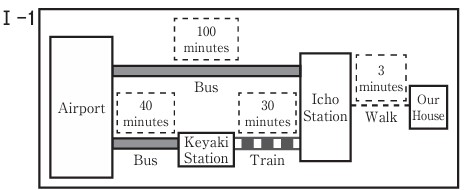
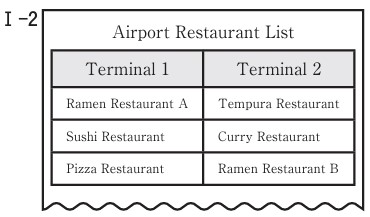
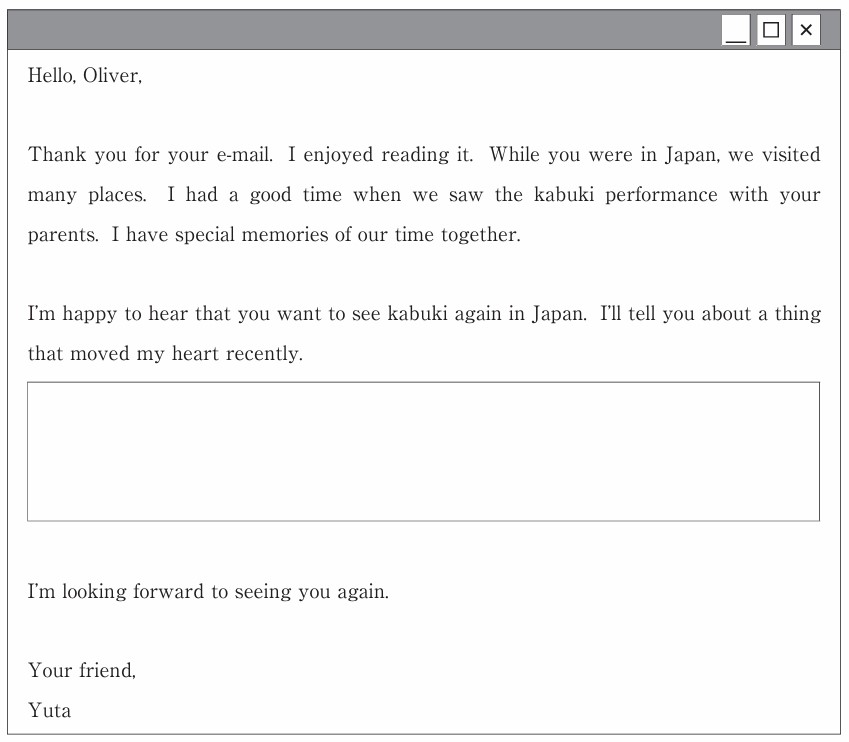
高校生の Yuta と,Yuta の家にホームステイしているオーストラリアからの留学生の Oliver は,来日する Oliver の両親を連れて空港から家に帰るまでの経路と昼食の予定について話をしている。(A)及び(B)の中に,それぞれ入る語句の組み合わせとして正しいものは,下のア〜エのうちではどれか。ただし,下のⅠ-1は,二人が見ている空港から Yuta の家までの経路と所要時間について Yuta が書いたメモであり,Ⅰ-2は,二人が見ている空港内にある飲食店の案内の一部である。
Yuta:Are your parents going to come to Japan on July 29th?
Oliver:Yes, they will arrive at *Terminal 2 of the airport at eleven in the morning.
Yuta:OK. After we meet your parents at the airport, let’s have lunch and take a bus to go to our house.
Oliver:Yes. We can choose one of two buses, right?
Yuta:That’s right. Which one should we take?
Oliver:It will be better for my parents to get home earlier. What do you think?
Yuta:Well…, if we choose the faster way, we will have to take a train after getting off the bus. That will be hard for people with a lot of *baggage.
Oliver:My parents will bring heavy baggage. We don’t have to take the faster way.
Yuta:I see. Let’s take the bus to (A) . It’s a longer trip, but I think it’s better.
Oliver:OK. How about lunch? There are many restaurants in the airport.
Yuta:Yes. What kind of food do your parents like?
Oliver:They both like ramen. Let’s have ramen at the terminal that my parents will arrive at.
Yuta:OK. Let’s go to (B).
〔注〕terminal ターミナル baggage 荷物
ア (A) IchoStation (B) RamenRestaurant A
イ (A) KeyakiStation (B) RamenRestaurant A
ウ (A) IchoStation (B) RamenRestaurant B
エ (A) KeyakiStation (B) RamenRestaurant B
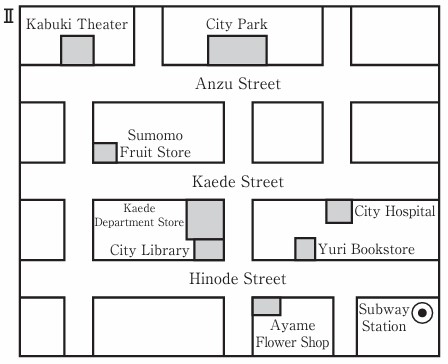
Yuta と Oliver,来日した Oliver の両親の四人は,歌舞伎が見られる劇場への行き方について,地図を見ながら話をしている。 (A)及び(B)の中に,それぞれ入る単語・語句の組み合わせとして正しいものは,右のページのア〜エのうちではどれか。ただし,右のページのⅡは,四人が見ている地図の一部であり,地図中の⦿は四人が話をしている地下鉄の駅の出入口を示している。
Oliver’s father:How can we get to the Kabuki Theater?
Yuta:Look at this map. We can walk to the Kabuki Theater from here at the station.
Oliver’s mather:OK. Do we have time to go shopping before seeing
kabuki? I want to buy something Japanese.
Yuta:Yes. Let’s go to Kaede Department Store.
Oliver:How can we get there?
Yuta:We can go along Hinode Street until (A) is on our left. Then we
can turn right at that corner. The store will be next to the City Library.
Oliver:OK.
Yuta:After shopping, we’ll go along Kaede Street to Sumomo Fruit Store. It will be on our (B). Then we can turn right at that corner. We’ll see the Kabuki Theater in front of us. It’s very beautiful.
Oliver’s mather:Thank you, Yuta.
Oliver’s father:OK. Let’s go.
ア (A) Ayame Flower Shop (B) right
イ (A) City Library (B) right
ウ (A) Ayame Flower Shop (B) left
エ (A) City Library (B) left
次の文章は,オーストラリアに帰国した Oliver が Yuta に送ったEメールの内容である。
Dear Yuta,
Thank you for helping me a lot during my stay in Japan. I had a good time. The kabuki I saw at the end of my stay in Japan is one of my best memories. I didn’t know much about traditional Japanese culture, but their performance was very powerful. My heart was moved by it. I really want to see kabuki again.
After returning to my country, my parents enjoyed watching kabuki in English on the Internet. After I saw kabuki in Japan, I became interested in drama, and I want to join the Drama Club in my school. If I join it, I want to practice singing and dancing a lot and then perform on a stage.
Next month, my parents are going to see kabuki at a theater. I won’t be able to go with them, but I want to see kabuki again in Japan someday.
Has something moved you recently? If something has moved you, please tell me about it. I’m looking forward to hearing from you.
Yours,
Oliver
⑴ このEメールの内容と合っているのは,次のうちではどれか。
ア Oliver saw kabuki with his parents at a theater after he returned to Australia.
イ Oliver knew much about traditional Japanese culture when he saw kabuki.
ウ Oliver practiced singing and dancing before he came to Japan.
エ Oliver wanted to join his school’s Drama Club after seeing kabuki.
⑵ YutaはOliverに返事のEメールを送ることにしました。あなたがYutaだとしたら,Oliverにどのような返事のEメールを送りますか。次の<条件>に合うように,下の□の中に、三つの英語の文を書きなさい。
<条件>
・前後の文につながるように書き,全体としてまとまりのある返事のEメールとすること。
・Oliverに伝えたい内容を一つ取り上げ,それを取り上げた理由などを含めること。
ウ
「Oliver:Yes, they will arrive at *Terminal 2 of the airport at eleven in the morning.」より、Oliverの両親は午前11時にターミナル2に到着することが分かる。その後、「Oliver:They both like ramen. Let’s have ramen at the terminal that my parents will arrive at.」より、両親はラーメンが好きでターミナルに到着したらラーメンを食べようと言っているので、 (B) はTerminal 2のRamen Restaurant が適切となり、図Ⅰ-2よりRamen Restaurant B が正しいと分かる。
図Ⅰ-1より、Icho StationとKeyaki Stationを確認する。「Yuta:Well…, if we choose the faster way, we will have to take a train after getting off the bus. That will be hard for people with a lot of *baggage.」「Oliver:My parents will bring heavy baggage. We don’t have to take the faster way.」より、早いほうを選ぶとバスを降りてから電車に乗るので荷物が大変である、そしてOliverの両親はたくさんの荷物を持っているので早いほうに乗るのはやめようと話している。図Ⅰ-1より、早いほうはKeyaki Stationであるため、(A)で選ぶのはIcho Stationであることが分かる。
ア
「Yuta:Yes. Let’s go to Kaede Department Store.」よりKaede Department Storeを経由するルートであることを確認する。
「Yuta:We can go along Hinode Street until (A) is on our left.」より、Hinode Streetを真っ直ぐ進む、(A)が左手に見えるまでということなので、図Ⅱから(A)はAyame Flower Shopであることを確定させる。
その後「Yuta:After shopping, we’ll go along Kaede Street to Sumomo Fruit Store. It will be on our (B).」とあり、 Kaede StreetをSumomo Fruit Storeのところまで真っ直ぐ行く。Sumomo Fruit Storeは私たちの(B)にある、という意味になるので、(B)の答えは右側のrightになる。
(1) エ
ア:Oliver saw kabuki with his parents at a theater after he returned to Australia.
本文にThe kabuki I saw at the end of my stay in Japan is one of my best memories. とあり、kabukiを日本で見たことが分かるため不適。
イ:Oliver knew much about traditional Japanese culture when he saw kabuki.
本文にI didn’t know much about traditional Japanese culture, but…とあり、日本の伝統文化について詳しい訳ではないと言っているため不適。
ウ:Oliver practiced singing and dancing before he came to Japan.
本文にI want to practice singing and dancing a lot and then perform on a stage.とあり、練習したい、という内容であるため不適。
(2) 【解答例】I went to a museum to see famous pictures painted by my favorite artist. Later, I saw those pictures in a book in an art class. The pictures I saw in the museum looked more beautiful than the pictures in the books.
解説略
LINE問合せ窓口
LINEからもお問合せいただけます!

公式Instagram
勉強のお役立ち情報を配信中!
お問い合わせ、ご質問も受付中です!

ご質問などお気軽にお問い合わせください。
次の対話の文章を読んで,あとの各問に答えよ。(*印の付いている単語・語句には,本文のあとに〔注〕がある。)
Ryota, Maki, and Hiro are junior high school students in Tokyo. Emma is a high school student from the United States. They are talking in a classroom after school.
Ryota:Maki, you are a member of the *Library Committee, right? More students go to the library these days. Have the *committee members been doing something special?
Maki:Yes. We change the books on the shelves in front of the library every week. We did that once a month before. Now many students come to see the books. I’m very happy.
Emma:₁.That’s great.
Maki:Actually, it was the idea of some students who didn’t usually come to the library. I learned something interesting from them.
Hiro:Tell me more.
Maki:When they passed by the library, they saw the books on the shelves. And sometimes they picked them up.
Ryota:Did they go into the library?
Maki:Yes. When they were interested in the books, they did. When we changed books on the shelves more often, more students came into the library.
Hiro:Great. I also want to do something as a member of the Broadcasting Committee. I want to change the lunch time school broadcasting.
Maki:Sometimes it’s good to try new things.
Emma:That’s true. Can I tell you about one of my experiences?
Hiro:Sure.
Emma:Before coming to Japan, I studied Japanese for the first time. But when I started to go to school in Japan, it was difficult to speak it.
Ryota:₂. You had a hard time. I didn’t know that.
Emma:At that time, I couldn’t say the things that I really wanted to say in Japanese. But I’m OK now.
Hiro:How did you solve your problem?
Emma:I didn’t solve it by myself. One day, one of the English Club members asked me some questions about English. Then I started to go to the club to teach English.
Maki:That was good for the club members.
Emma:I hope so. Then I talked about my problem there. One of the members said, “You are kind to teach us English. If you want to speak Japanese, please talk to me.”
Hiro:That sounds good.
Emma:In the English Club, the members and I can teach each other.
Maki:₃.That’s nice.
Emma:I can understand Japanese better and have many good friends now.
Maki:Great. Talking to someone about your problems is important.
Ryota:Right. I had a similar feeling when I did a presentation in my social studies class.
Maki:I remember. You did a presentation about a country you wanted to visit.
Ryota:Yes. When I practiced for the presentation, I used all the information that I had, and the presentation became too long.
Hiro:Then what did you do?
Ryota:I showed my presentation to some friends before I did it in front of the class. ₄.They gave me good advice.
Maki:What did they say?
Ryota:First, they asked me what the most important point of the presentation was.
Hiro:What was their advice?
Ryota:They said I should focus on that point. I used only some important information. That made the presentation better.
Hiro:It’s important to hear different points of view. And other people sometimes can give us good help.
Emma:Do you think you can also do something as a Broadcasting Committee member?
Hiro:We do lunch time school broadcasting every day. But I want to understand students’ feelings about it. After that, I will try something new. I want chances to talk to students about it.
Maki:That’s a good idea.
Hiro:First, I’ll talk to some of my friends. They may give me some new ideas.
Ryota:₅.I hope they will do that.
Hiro:I’m glad that I talked to you all about this.
〔注〕 Library Committee 図書委員会 committee 委員会
〔問1〕 ₁.That’s great. とあるが,このように Emma が言った理由を最もよく表しているのは,次の うちではどれか。
ア Many students come to see the books on the shelves in front of the library.
イ The Library Committee members change the books on the shelves in front of the library once a month.
ウ Students who didn’t usually go to the library had an interesting idea.
エ Students go to the library to do something special.
〔問2〕 ₂. You had a hard time. の内容を最もよく表しているのは,次のうちではどれか。
ア The English Club members couldn’t ask questions to Emma.
イ Emma studied Japanese for the first time before she came to Japan.
ウ It was difficult for Emma to speak Japanese when she started to go to school in Japan.
エ Ryota didn’t know what Emma wanted to say in Japanese when she came to Japan.
〔問3〕 ₃.That’s nice.とあるが,このように Maki が言った理由を最もよく表しているのは,次の うちではどれか。
ア One of the English Club members said Emma was kind.
イ The English Club members and Emma can teach each other.
ウ Emma hoped the English Club members could talk about their problems with her.
エ Ryota and Maki have a similar feeling about the English Club.
〔問4〕 ₄.They gave me good advice.の内容を,次のように書き表すとすれば,[ ]中に,下のどれを入れるのがよいか。
Ryota’s friends said that[ ].
ア Ryota should sometimes give other people help.
イ Ryota should focus on the most important point of the presentation.
ウ Ryota should show other people his presentation before doing it in front of the class.
エ Ryota should use all the information he had to make the presentation long.
〔問5〕 ₅.I hope they will do that. の内容を最もよく表しているのは,次のうちではどれか。
ア Hiro and his friends will have chances to do lunch time school broadcasting.
イ Some students will understand the Broadcasting Committee members’ feelings.
ウ The Broadcasting Committee members will do lunch time school broadcasting every day.
エ Hiro’s friends will give him some new ideas about lunch time school broadcasting.
〔問6〕 次の英語の文を,本文の内容と合うように完成するには,[ ]の中に,下のどれを 入れるのがよいか。
Hiro learned that it sometimes is important to learn [ ]ways of looking at things from others.
ア different
イ exciting
ウ famous
エ similar
〔問7〕 次の文章は,Maki たちと話した日に,Emma が書いた日記の一部である。 [ A ]及び [ B ]の中に,それぞれ入る単語・語句の組み合わせとして正しいものは,下のア〜エの うちではどれか。
Today, I talked with my friends Ryota, Maki, and Hiro about getting new ideas. Maki was happy that many students came to the library. And students who didn’t usually go to the library [ A ]her. I told my friends about one of my experiences. When I spoke Japanese, I had a problem. One of the English Club members understood my problem. And we solved it. Ryota’s friends also [ A ]him. They gave him good advice [ B ]he gave a presentation in front of the class. His presentation became better. I think it is important to talk about my problems to other people. Sometimes they give me good advice. Hiro wanted to change the lunch time school broadcasting. He wanted to understand students’ feelings [ B ]trying something new. I hope he will get good ideas from others.
ア (A) helped (B) after
イ (A) learned from (B) after
ウ (A) helped (B) before
エ (A) learned from (B) before
ア
Maki:Yes. We change the books on the shelves in front of the library every week. We did that once a month before. Now many students come to see the books. I’m very happy. この部分でMakiが幸せであることが伝わるので、ここに対する応答としてThat’s great.となる。
ウ
Emma:Before coming to Japan, I studied Japanese for the first time. But when I started to go to school in Japan, it was difficult to speak it.
この部分でEmmaが苦労をしたことが伝わるので、ここに対する応答としてYou had a hard time. となる。
イ
Emma:In the English Club, the members and I can teach each other.この部分でEmmaがEnglish Culbでメンバーと互いに教えあうことができる、という内容に好感を持ったリアクションとして、That’s nice.と返している。
イ
Ryota:₄.They gave me good advice.
Maki:What did they say?
Ryota:First, they asked me what the most important point of the presentation was.
Hiro:What was their advice?
Ryota:They said I should focus on that point. I used only some important information. と会話が続いているので、
イ Ryota should focus on the most important point of the presentation.が内容として適切である。
エ
直前の「Hiro:First, I’ll talk to some of my friends. They may give me some new ideas.」に対する応答である。TheyはHiro’s friendsを指している。
ア
「Hiro:It’s important to hear different points of view. And other people sometimes can give us good help.」
この部分が問題にあるHiro learned that it sometimes is important to learn [ ]ways of looking at things from others.と内容が合致しているため、ここからdifferentだと決定する。
ウ
[ A ]本文にI showed my presentation to some friends before I did it in front of the class. They gave me good advice.とあるように、Ryotaの友達がRyotaから学んだのではなく、Ryotaが友達からアドバイスをもらい、助けられたので helped が適切である。
[ B ]He wanted to understand students’ feelings [ B ]trying something new. は、本文中の「Hiro:We do lunch time school broadcasting every day. But I want to understand students’ feelings about it. After that, I will try something new. I want chances to talk to students about it.」と合致する内容である。本文中でHiroは生徒がどう感じるかを理解した後に新しいことをやりたいという主旨のことを話しているので、[ B ]はbeforeではなくafterが適切である。
次の文章を読んで,あとの各問に答えよ。(*印の付いている単語・語句には,本文のあとに〔注〕がある。)
Yumi was a Japanese second-year high school student. She was good at English, and she was interested in going abroad. She wanted to see how well she could communicate in English. One day in May, on the Internet, she found information about a *homestay in New Zealand for two weeks during the summer vacation. Yumi was interested in it and talked to her brother, Masao, about it. She asked him about his homestay experience in Canada. Masao said to her, “I enjoyed speaking English and making many friends there. You should do that in the New Zealand program.” She was looking forward to going to a high school during the homestay. She hoped to introduce something Japanese to people.
One Wednesday in early August, Yumi arrived in New Zealand and met Lily and Jack, members of her *host family. Yumi and Lily were the same age, and Jack was six years old. Yumi talked about many things with them. Soon they became good friends.
On Saturday, Yumi and Lily went to a *farm near Lily’s house. Lily often took care of cows and sheep. Yumi wasn’t able to help her very well. But she enjoyed it. Lily said to her, “I’ve been helping the farm to take care of these cows and sheep. I want to become a farmer. I want people to eat ice cream made from milk from my farm.” Then Lily asked Yumi, “What do you want to do in the future?” Yumi couldn’t answer anything. She didn’t have a clear plan for the future. She became a little *embarrassed about that.
On Sunday, Yumi played with Jack. She made some origami for Jack, such as a paper *balloon and a crane. Jack enjoyed throwing the paper balloon and said to Yumi, “Can you make some other things, like a rugby ball? I like playing rugby.” Yumi said, “Let’s check how to make one.” She found some origami websites. She tried to make a rugby ball, and she made one. But Jack couldn’t make one at first. Thanks to help from Yumi, he later made an origami rugby ball. He said, “Thank you very much!” Yumi thought that origami could be a chance for Jack to learn about Japan.
On Tuesday, at school, Yumi got a chance to introduce August events in Japan to her class. She talked about summer festivals and showed a video about fireworks and food *stalls. People in the video ate various kinds of food. Some classmates became interested in okonomiyaki and asked Yumi about it. She said, “It’s made from *flour, eggs, and cabbage. You can put anything you like into it.” After school, one of her classmates, Kate, invited Yumi and Lily to a party which would be held on the weekend. Kate wanted to make okonomiyaki with her family. She invited neighbors and asked Yumi for help.
Four days later, the party was held. People there enjoyed making okonomiyaki with the help of Yumi. Yumi was happy that they made various kinds of okonomiyaki . One of the invited neighbors put bacon and green peppers in it. Lily said, “okonomiyaki was a good idea and not difficult to make.” Kate said, “Thank you, Yumi. You are a good teacher.” Yumi was happy to see their smiles. She felt that the party would be one of the best memories of her stay.
The next day was Yumi’s last day in New Zealand. She said to Lily and Jack, “I want to learn more about my own country and tell people from other countries about Japan.” Lily said, “You will be able to do that in the future.”
Yumi came home from New Zealand and said to Masao, “My homestay in New Zealand was a great experience. I want to go there again. I want to learn more English and more about Japan.” Masao was happy to hear that. Yumi smiled.
〔注〕 homestay:ホームステイ host family:ホストファミリー farm:牧場 embarrassed:気恥ずかしい balloon:風船 stall:屋台 flour:小麦粉
〔問1〕 You should do that in the New Zealand program. の内容を,次のように書き表すとすれば,[ ]の中に,下のどれを入れるのがよいか。
Masao told Yumi that[ ].
ア she should go to a high school in the New Zealand program
イ she should introduce something Japanese in the New Zealand program
ウ she should find information about high schools in the New Zealand program
エ she should enjoy speaking English and making many friends in the New Zealand program
〔問2〕 次のア〜エの文を,本文の内容の流れに沿って並べ,記号で答えよ。
ア Yumi was happy that people at the party made various kinds of okonomoyaki.
イ Yumi talked about many things with Lily and Jack, and they became good friends.
ウ Lily said that Yumi would be able to tell people from other countries about Japan in the future.
エ Yumi was interested in going abroad and wanted to see how well she could communicate in English.
〔問3〕 次の⑴〜⑶の文を,本文の内容と合うように完成するには,[ ]の中に,それぞれ下のどれを入れるのがよいか。
⑴ When Lily asked Yumi about her future,[ ].
ア Yumi couldn’t answer because she didn’t have a clear plan
イ Yumi said she wanted people to eat ice cream made from milk from her farm
ウ Yumi was a little embarrassed because she couldn’t take care of cows and sheep
エ Yumi said she wanted to become a farmer in New Zealand
⑵ On Sunday, when Jack asked Yumi to make an origami rugby ball,[ ].
ア she tried to make one and enjoyed throwing it
イ she thought making one would be a good chance for her to learn about Japan
ウ she said she could make other things, like a paper balloon and a crane
エ she found some origami websites and made one
⑶ On Tuesday, after Yumi talked about August events in Japan at school,[ ].
ア Yumi showed classmates a video about origami
イ Kate asked Yumi to help to make okonomiyaki at a party
ウ Kate was invited to a party to help Lily make okonomiyaki
エ some classmates got interested in the fireworks in the video
〔問4〕 次の⑴,⑵の質問の答えとして適切なものは,それぞれ下のうちではどれか。
⑴ What did Yumi feel at the party?
ア She felt that putting bacon and green peppers in okonomiyaki was a good idea.
イ She felt that Kate’s family and invited neighbors were good teachers.
ウ She felt that it would be one of the best memories of her stay.
エ She felt that making okonomiyaki in New Zealand was difficult.
⑵ Why did Yumi want to learn more about her own country?
ア She wanted to learn more about it to talk with people at a party.
イ She wanted to learn more about it to tell people from other countries about Japan.
ウ She wanted to learn more about it to do a homestay in New Zealand again.
エ She wanted to learn more about it to talk with Masao more.
エ
You should do that in the New Zealand program. のthatは、前の文章であるI enjoyed speaking English and making many friends there. を指している。日本語訳としては「自分は英語を話すことを楽しみ、そこでたくさんの友達をつくった。あなたもニュージーランドの予定ではそうするといい。」という感じ。
エ → イ → ア → ウ
エ Yumi was interested in going abroad and wanted to see how well she could communicate in English.は、本文の冒頭部分の内容
↓
イ Yumi talked about many things with Lily and Jack, and they became good friends.は、本文第2段落の内容
↓
ア Yumi was happy that people at the party made various kinds of okonomoyaki.は、本文第6段落の内容
↓
ウ Lily said that Yumi would be able to tell people from other countries about Japan in the future.、本文第7段落の内容
(1) ア
第3段落のYumi couldn’t answer anything. She didn’t have a clear plan for the future. She became a little *embarrassed about that. から、内容が合致しているのはアであると判断する。
(2) エ
第4段落の“Let’s check how to make one.” She found some origami websites. She tried to make a rugby ball, and she made one.から、内容が合致しているのはエであると判断する。イは、she thought making one would be a good chance for Jack to learn about Japan であれば正しい。
(3) イ
第5段落のAfter school, one of her classmates, Kate, invited Yumi and Lily to a party which would be held on the weekend. Kate wanted to make okonomiyaki with her family. She invited neighbors and asked Yumi for help.から、内容が合致しているのはイであると判断する。
(1) ウ
第6段落のShe felt that the party would be one of the best memories of her stay.から、内容が合致しているのはウであると判断する。
(2) イ
最後の段落の“My homestay in New Zealand was a great experience. I want to go there again. I want to learn more English and more about Japan.” から、内容が合致しているのはイであると判断する。
LINE問合せ窓口
LINEからもお問合せいただけます!
公式Instagram
勉強のお役立ち情報を配信中!
お問い合わせ、ご質問も受付中です!
ご質問などお気軽にお問い合わせください。
家庭教師のやる気アシストは、東京都にお住まいの受験生のお子さんを毎年たくさん指導をさせ頂き、合格に導いています。
高い合格率の秘訣は、指導経験豊富な先生の指導力に加え、1対1の指導でお子さん一人ひとりの状況に合わせた、お子さんだけのカリキュラムで勉強が進められるから!
家庭教師のやる気アシストは、お子さんの志望校合格まで全力でサポートさせて頂きます!
LINE問合せ窓口
LINEからもお問合せいただけます!
公式Instagram
勉強のお役立ち情報を配信中!
お問い合わせ、ご質問も受付中です!
ご質問などお気軽にお問い合わせください。
お子さんにとって「成果が出る勉強法」ってどんな勉強法だと思いますか?
お子さんそれぞれに、個性や性格、学力の差もあります。そんな十人十色のお子さん全員に合う勉強法ってなかなかないんです。
たからこそ、受験生の今だけでもお子さんだけの勉強法で受験を乗り越えてみませんか?
やる気アシストには、決まったカリキュラムはありません。お子さんの希望や学力、得意や不得意に合わせて、お子さんだけのカリキュラムで指導を行っていきます。また、勉強法もお子さんそれぞれに合う合わないがあります。無料体験授業では、お子さんの性格や生活スタイルを見せていただき、お子さんにとって効率的な成果の出る勉強のやり方をご提案させて頂きます。