
神奈川県の2024年3月実施の令和6年度(2024年度)入学者の公立高校入試問題の解説をしています。
受験勉強において、過去問を解くことはとても効果的な勉強法です。ぜひ、受験までに一度挑戦し、問題の傾向を掴んでおきましょう。合わせて、対策などをたてられるととても良いですね。
また、過去問で苦手な点が見つかった場合は、そこを中心に試験日当日までにしっかりと対策しておきましょう。
問題アは,No.1 ~ No.3 まであります。Max とErika が話をしています。まずMax が話し,次にErika が話し,その後も交互に話します。対話の最後でErika が話す言葉のかわりに(チャイムの音)というチャイムが鳴ります。そのチャイムのところに入るErika の言葉として最も適するものを,問題アの指示にしたがって答えなさい。まず,問題アの指示を読みなさい。
(ア) チャイムのところに入るエリカの言葉として最も適するものを,次の1 ~ 4 の中からそれぞれ一つずつ選び,その番号を答えなさい。
No. 1
[ Max:] Erika, tell me how you became good at math.
[ Erika:] I studied math really hard last year because my math teacher told me that it was the only way.
[ Max:] We had two math teachers last year, Ms. Sato and Mr. Yamada. Which teacher taught you math ?
[ Erika:] (チャイム)
1. That’s the only way.
2. I did it last year.
3. Math was my favorite subject.
4. Ms. Sato did.
No.2
[ Max:] Erika, do you know our class will have a student from New Zealand next month ?
[ Erika:] Yes. Actually, she’s going to stay at my house while she is in Japan.
[ Max:] That’s great ! How long is she going to stay with your family ?
[ Erika:] (チャイム)
1. She’s going to be with us for six months.
2. She has never been to our house in Japan.
3. She has been studying Japanese for a year.
4. She will come back to Japan to stay with us.
No.3
[ Max:] Erika, what are you going to do this weekend ?
[ Erika:] I’m going to go shopping with my brother. My mother’s birthday is next week, and we need to get a present for her.
[ Max:] Wow, that’s nice ! What are you going to get ?
[ Erika:] (チャイム)
1. We haven’t decided yet.
2. We bought it yesterday.
3. I’ll get there soon.
4. It’s next Sunday.
問題イは,No.1 とNo.2 があります。それぞれ同じ高校に通うJanet とKen の対話を放送し
ます。対話の内容を聞いて,問題冊子に印刷されているそれぞれの質問の答えとして最も適するものを,問題イの指示にしたがって答えなさい。
(イ) 対話の内容を聞いて,それぞれのQuestion の答えとして最も適するものを,あとの1 ~ 4 の中から一つずつ選び,その番号を答えなさい。
No.1
Janet:Ken, I’ve learned what itadakimasu means. I learned it when I visited my Japanese friend’s house last weekend.
Ken:Tell me about it.
Janet:It’s not just “let’s eat.” It’s also “thank you for the food.”
Ken:I see. I also learned a thing from my aunt last weekend. She visited my house from Chiba. She said, “Let’s eat everything on the table.”
Janet:Oh, that’s another way to respect food, right ?
Ken:Yes, she said, “We can respect food by doing this.”
Question : Which is true about Janet’s and Ken’s weekend ?
1. Janet went to her friend’s house, and Ken traveled to Chiba.
2. Janet and Ken visited their Japanese friend’s house.
3. Janet and Ken learned different ways to respect food.
4. Janet and Ken learned how to cook Japanese food.
No.2
Janet:Ken, you said you had to go home quickly after school today. Why are you still here ?
Ken:Because I’ve lost my bike key. I can’t go home without it. I’m checking every room I used today, and this is the last room.
Janet:Have you checked the area around your bike ?
Ken:The area around my bike ?
Janet: Yes. When I lost my bike key last month, I found it on the ground in the parking lot.
Ken:You may be right ! I’ll go to the parking lot. Thanks, Janet.
Question : Which is true about Janet and Ken ?
1. Janet and Ken are walking home together because they lost their bike keys.
2. Janet and Ken are going to check another classroom to find Ken’s bike key.
3. Janet thinks Ken should stop worrying and get a new bike.
4. Ken thinks Janet’s idea about his bike key may be right.
(ウ) 留学生のベス(Beth)が友だちのユミの留守番電話にメッセージを残しました。メッセージを聞いて,次のNo.1 とNo.2の問いに答えなさい。
Hi, Yumi. This is Beth. I’m calling about our trip on Saturday. We are going to meet at Ueno Station and visit the art museum, the zoo, and the temple. Can we change our plan ? Our meeting time is 9:45 a.m., and that’s good for me. Then, after going to the art museum, let’s go to the science museum. It’s going to rain in the morning on that day, so we should stay inside. We can go to the zoo next time. The science museum is just across the street from the art museum. After that, let’s have lunch, and then, let’s go to the temple in the afternoon. It will be sunny then, so we can enjoy walking around the temple. What do you think about my idea ? Please call me later. Bye!
No.1 メッセージを聞いてユミが作った次の<メモ>を完成させるとき,① ~ ③の中に入れるものの組み合わせとして最も適するものを,あとの1 ~ 6 の中から一つ選び,その番号を答えなさい。
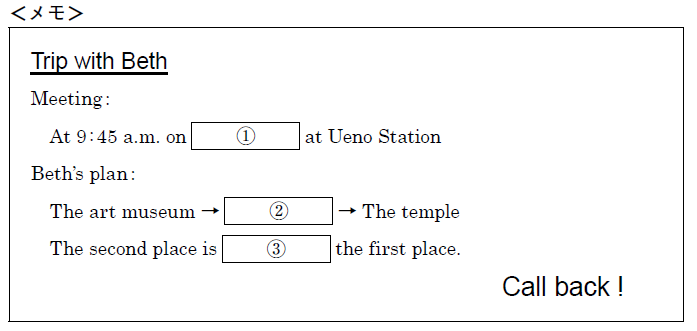
No.2 次のQuestion の答えとして最も適するものを,あとの1 ~ 4 の中から一つ選び,その番号を答えなさい。
Question : Why did Beth leave the message ?
1. To recommend a science event.
2. To make an idea to save money.
3. To change a place they will go to.
4. To decide how to go to Ueno.
(ア)
No.1 4
チャイムの前に聞かれたことは「Which teacher taught you math ?」なので、先生の名前について書かれている4が正しい。
No.2 1
チャイムの前に聞かれたことは「How long is she going to stay with your family ?」なので、彼女が滞在する期間について書かれている1が正しい。また、How long is she going で未来の予定について聞かれているため、解答も未来形が使われているものから判断していくとよい。
No.3 1
チャイムの前に聞かれたことは「What are you going to get ?」なので、プレゼントに何をゲットする予定なのか?という問いに答えている1を選ぶ。
(イ)
No.1 3
1,2は「I also learned a thing from my aunt last weekend. She visited my house from Chiba.」つまりKenのおばが千葉から来たということなので不適。4は料理を作ったわけではないので不適。
No.2 4
Janet: Yes. When I lost my bike key last month, I found it on the ground in the parking lot.
Ken:You may be right ! I’ll go to the parking lot. Thanks, Janet.
ここからKenがJanetのアドバイスに賛同していることがわかるため4が正しいと判断する。
(ウ)
No.1 2
①は I’m calling about our trip on Saturday.から判断。②はThen, after going to the art museum, let’s go to the science museum.から判断。③はThe science museum is just across the street from the art museum. から判断する。
No.2 3
Can we change our plan ?と聞いているので3と判断する。
(ア) Someone moved in the house next to mine. The new( )came to my house this morning to say hello.
1. course
2. degree
3. neighbor
4. theater
(イ) When you share your opinions on the Internet, you must remember that your words may( )someone’s feelings.
1.fall
2. fold
3. hurt
4. miss
(ウ) Kamome Computer became a very( )computer company because it made fast computers with powerful batteries and sold them at a low price.
1.careful
2. official
3. similar
4. successful
(ア) 3
1. course(コース・講座)
→ 学校の授業や道筋のこと。人のことではない。✕
例:an English course(英語のコース)
2. degree(ディグリー・学位/温度の度)
→ 学校の「学位」や「温度の度数」など。人ではない。✕
例:a university degree(大学の学位)
3. neighbor(ネイバー・近所の人、隣人)
→ 「隣に住む人」という意味。今回の文に適切◎
4. theater(シアター・劇場)
→ 建物の名前(映画館や劇場)。人ではない。✕
(イ) 3
1. fall(落ちる)
→ 「気持ちを落ちる」にはならないので ✕
例:Leaves fall from the tree.(木から葉が落ちる)
2. fold(折りたたむ)
→ 紙や服などを「折る」という意味。気持ちには使えません。✕
例:Fold the paper in half.(紙を半分に折って)
3. hurt(傷つける)
→ 「〜を傷つける」
例:Don’t hurt me.(私を傷つけないで)
今回の文では「hurt someone’s feelings(人の気持ちを傷つける)」という決まり文句です。
4. miss(~を逃す/~がいなくて寂しい)
→ 「授業を休む」「友だちがいなくて寂しい」などの意味。
気持ちを“miss”するのはおかしい。✕
例:I miss my friends.(友だちがいなくて寂しい)
(ウ) 4
1. careful(注意深い)
→「注意深い会社」では文の意味が合いません。✕
例:He is careful when he drives.(彼は運転するとき注意深い)
2. official(公式の/公的な)
→「公式な会社」も文の流れに合わない。✕
例:This is the official website.(これは公式サイトです)
3. similar(似ている)
→「似ている会社」だと、何に似ているのか不明。意味がつながらない。✕
例:Your bag is similar to mine.(あなたのかばんは私のに似ている)
4. successful(成功した)
→「成功した」「うまくいった」
例:She is a successful singer.(彼女は成功した歌手です)
今回の文に適切です。
LINE問合せ窓口
LINEからもお問合せいただけます!

公式Instagram
勉強のお役立ち情報を配信中!
お問い合わせ、ご質問も受付中です!

ご質問などお気軽にお問い合わせください。
次の(ア)~(エ)の文の( )の中に入れるのに最も適するものを,あとの1 ~ 4 の中からそれぞれ一つずつ選び,その番号を答えなさい。
(ア)
A : Can you put that table by the door ?
B : The table looks heavy, so( )it without your help will be difficult.
1.move 2. moving 3. has moved 4. is moved
(イ)
A : Dad, let’s try( )different tonight ! How about having dinner on the floor ?
B : Sounds great. It’s like a picnic at home.
1.another 2. a thing 3. one 4. something
(ウ)
A : Happy birthday, Mr. Johnson. This is a party for your thirtieth birthday !
B : Oh, thank you, everyone. Let me( )a short speech.
1.make 2. made 3. making 4. to make
(エ)
A : What do you think about the new Japan national baseball team?
B : I think the members are amazing, but we don’t know much about the team because it has played only two games( )teams of other countries.
1.against 2. during 3. than 4. until
(ア) 2
1. move ✕
→ 「move it will be difficult」は文法的に変。
「move」は動詞の原形で、「~すること」という意味になりません。
2. moving ◎
→ 動名詞で「動かすこと」という意味になり、文全体が自然。
例:Moving it will be difficult.(それを動かすことは難しい)
3. has moved ✕
→ 「動かした(完了形)」の意味。ここでは「動かすこと」だから合わない。
4. is moved ✕
→ 「動かされる(受け身)」の意味。文の主語は “it” ではなく “moving it” なので不自然。
(イ) 4
1. another ✕
→ 「もう1つの」「別の」という意味で、後ろに名詞が必要。
例:Let’s try another game.(別のゲームをやってみよう)ここでは「another different」は文法的におかしい。
2. a thing ✕
→ 「try a thing different」は不自然。
普通「a thing different」なんて言い方はしません。
3. one ✕
→ 「one different」も文法的に間違い。「something different」とは言えるけど、「one different」とは言えません。
4. something ◎
→ 「something different」=「何かちがうこと」英語で「何か」は something。
(ウ) 1
1. make ◎
→ 「Let me make a short speech.」=「短いスピーチをさせてください」文法的にも意味的にも適切です。
2. made ✕
→ 「make」の過去形。「Let me made」は文法的に間違いです。
3. making ✕
→ 「make」の -ing 形。「Let me making」も文法的に使えません。
4. to make ✕
→ 「Let me to make」も間違い。※「let」の後には to はつけません。
(エ) 1
1. against ◎
→ 「〜と対戦して」意味も文法も適切です。
2. during(〜の間に) ✕
→ 「試合の間に」など時間を表すときに使う。ここでは合わない。
例:during the game(試合の間に)
3. than(〜よりも)」✕
→ 比較するときに使う。
例:taller than me(私より背が高い)
4. until(〜まで)」✕
→ 時間の終わりを表す。
例:until 10 o’clock(10時まで)
次の(ア)~(エ)の対話が完成するように,( )内の六つの語の中から五つを選んで正しい順番に並べたとき,その( )内で3 番目と5 番目にくる語の番号をそれぞれ答えなさい。
(それぞれ一つずつ不要な語があるので,その語は使用しないこと。)
(ア)
A : That’s my favorite fruit. Jessica, ( 1. do 2. you 3. what 4. is 5. it 6. call ) in English ?
B : It’s a watermelon.
(イ)
A : When are we going to practice for this weekend’s concert ? Sam, ( 1. better 2. day 3. which 4. popular 5. for 6. is ) you, today or tomorrow ?
B : Tomorrow is perfect. I will bring my guitar.
(ウ)
A : Excuse me. I forgot where I put my shoes when I entered the temple. That was about an hour ago.
B: All the( 1. visitors 2. were 3. shoes 4. off 5. took 6. the ) are on that shelf over there.
(エ)
A : Did you enjoy playing soccer ?
B: Yes. Though it( 1. difficult 2. some 3. was 4. understand 5. I 6. to ) of the rules, I had so much fun.
(ア) 3番目:2 5番目:5
正しい文:What do you call it in English?(それを英語でなんて言うの?)
(イ) 3番目:6 5番目:5
正しい文:Which day is better for you, today or tomorrow?(今日と明日、どちらがあなたにとって都合がいい?)
(ウ) 3番目:1 5番目:4
正しい文:All the shoes the visitors took off are on that shelf over there.(訪問者たちが脱いだ靴は、すべてあそこの棚の上にあります。)
(エ) 3番目:6 5番目:2
正しい文:Though it was difficult to understand some of the rules, I had so much fun.(ルールのいくつかは理解するのが難しかったけれど、とても楽しかったです。)
LINE問合せ窓口
LINEからもお問合せいただけます!
公式Instagram
勉強のお役立ち情報を配信中!
お問い合わせ、ご質問も受付中です!
ご質問などお気軽にお問い合わせください。
次のA~ C のひとつづきの絵と英文は,ミチコ(Michiko)とアン(Anne)の会話を順番に表しています。Aの場面を表す<最初の英文>に続けて,B の場面にふさわしい内容となるように, [ ]の中に適する英語を書きなさい。ただし,あとの<条件>にしたがうこと。
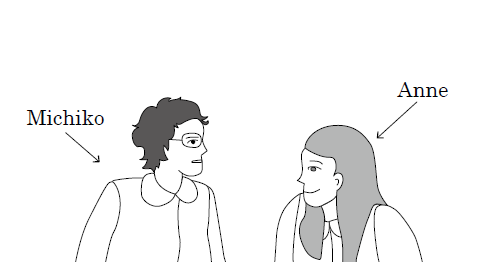
<最初の英文>
Michiko talked to Anne about the wheelchair basketball game she watched at the Kamome Sports Center last weekend.
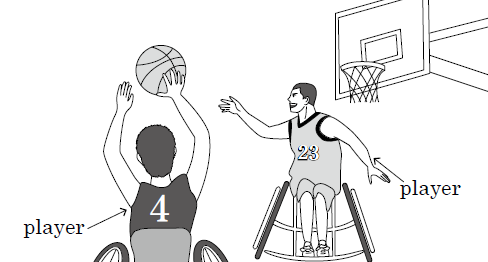
Michiko said, “The game was really exciting. The players moved very fast, and the wheelchairs hit each other. I’m now a fan of this sport.” Anne said, “Sounds exciting, ” and she asked, “ [ ] a wheelchair basketball game ?”
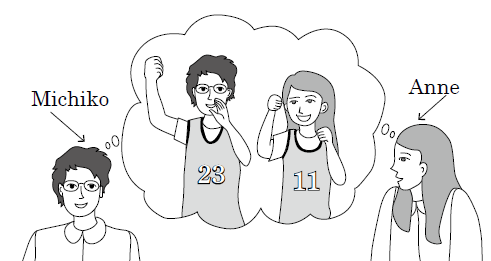
“Twice,” Michiko answered, and she said, “Once with my family and once with my friend. Would you like to watch a game with me this weekend, Anne ?” Anne said, “Sure ! I can’t wait !”
<条件>
① times とwatched を必ず用いること。
② ①に示した語を含んで,[ ] 内を6語以上で書くこと。
③ a wheelchair basketball game ? につながる1 文となるように書くこと。
※ 短縮形(I’m やdon’t など)は1 語と数え,符号( , など)は語数に含めません。
〈正答例〉 How many times have you watched (a wheelchair basketball game?)
Cで、MIchikoが”Twice.”と答えていることや、その後の文章から車いすバスケットボールを見たことがある回数を聞いたことがわかる。
回数を尋ねるときはHow many times, 経験について表すときは現在完了形(have + 過去分詞)を使用しましょう。
次の英文は,高校生のチナツ(Chinatsu)が英語の授業でクラスの生徒に向けて行ったスピーチの原稿です。英文を読んで,あとの(ア)~(ウ)の問いに答えなさい。
Green or *gray ? Nature or *concrete ? Living together with trees and plants or without them ? Which should we choose ? Today, I will talk about green *infrastructure. In a city, we need different kinds of *buildings or services like hospitals, parks, or train systems to support modern
human life. These things are examples of infrastructure. Green infrastructure is a way of supporting and protecting modern human life by using nature.
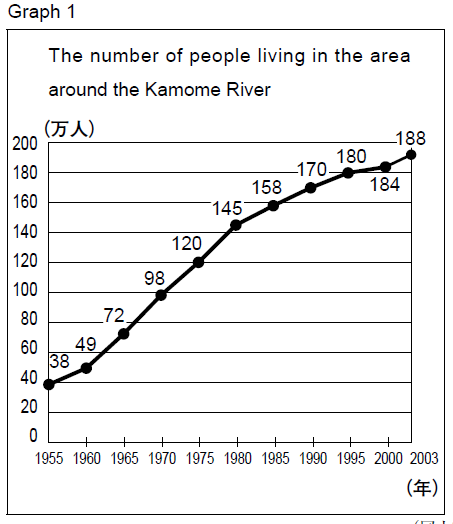
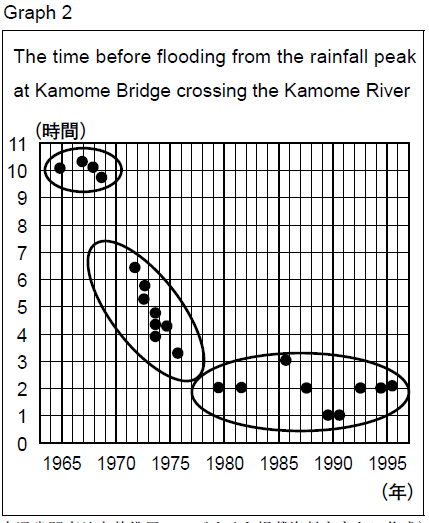
Today, towns and cities have changed because of gray infrastructure. Please look at *Graph 1. This shows 1,500,000 more people started to live in the area around the Kamome River during these 48 years. Gray infrastructure was developed for people living there, and this area is now covered with concrete. In the past, when towns and cities had lots of green areas, *flooding didn’t happen quickly because rain water stayed in the ground during heavy rain. However, when nature is lost because of gray infrastructure, rain water runs into the river very fast during heavy rain. Graph 2 shows the time before flooding from the *rainfall peak in the area around the Kamome River. It was about 10 hours between 1965 and 1969, and it was about 2 hours between 1979 and 1996. From the information in Graph 1 and Graph 2, you will realize that [ ] because the time before flooding from the rainfall peak became shorter.
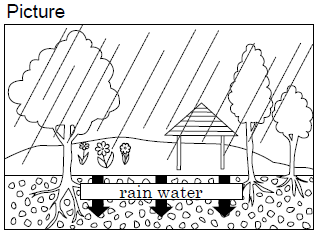
Now I will show you an example of green infrastructure that will protect our cities during heavy rain. Please look at this picture of a rain garden. It’s a water system. It holds rain water in the ground. Its ground is covered with trees and plants, and broken *stones are put in the ground.
Concrete covers most areas in our cities, but flooding won’t happen quickly if we have rain gardens in many places in our cities.( ① )
Green infrastructure helps people have active lives in cities. Now, I will introduce the *Singapore Green Plan 2030. Singapore plans to *plant 1,000,000 more trees across the country. In Singapore, green infrastructure is built in the city or near the city, so people can walk to green areas like parks and gardens from their houses easily. Trees create air for humans, and trees clean the air in the city. They also create a cool environment in the city because some of the light from the sun doesn’t reach the ground. People can use those green areas in the way they like. They can enjoy the view of beautiful flowers, have a picnic with family members, and play sports with friends.( ② )People become more active in cities by spending time in green areas.
Finally, I’d like to introduce my plans for green infrastructure in our school. I believe green infrastructure will make our school life better. I hope to make green areas between the school gate and the school building. Under the trees, the students will enjoy time with friends. Also, I want to
create a cool environment in our school by covering the school buildings with goya *vines.( ③ ) If you like my idea, please join me.
Green or gray ? I don’t think that’s the right question. Now we have to ask this. How can we all work together to live with nature ? Green infrastructure is the key to improving our lives.
* gray:灰色の concrete:コンクリート infrastructure:インフラストラクチャー(社会の基礎となる施設) buildings:建物 Graph:グラフ flooding:洪水 rainfall peak:降雨の最盛時 stones:石 Singapore:シンガポール plant ~:~を植える vines:つる
(ア) 本文中の [ ] の中に入れるのに最も適するものを,次の1 ~ 4 の中から一つ選び,その番号を答えなさい。
1. towns and cities in this area became larger, and many people there may get into dangerous situations faster than before during heavy rain
2. this area’s infrastructure is weak when flooding happens, and the number of people living in this area went down
3. more people started to live in this area, and no one there needs to gather information about protecting their towns and cities from flooding
4. the number of people living in this area continued to rise, and people do not need to worry about losing their houses even during heavy rain
(イ) 本文中の( ① )~( ③ )の中に,次のA~ Cを意味が通るように入れるとき,その組み合わせとして最も適するものを,あとの1 ~ 6 の中から一つ選び,その番号を答えなさい。
A. Living together with nature is good for our health.
B. By doing these things, I hope to start my green infrastructure movement here.
C. I’m sure that green infrastructure will make our cities safe.
1. ①-A ②-B ③-C
2. ①-A ②-C ③-B
3. ①-B ②-A ③-C
4. ①-B ②-C ③-A
5. ①-C ②-A ③-B
6. ①-C ②-B ③-A
(ウ) 次のa ~ f の中から,チナツのスピーチの内容に合うものを二つ選んだときの組み合わせとして最も適するものを,あとの1 ~ 8 の中から一つ選び,その番号を答えなさい。
a . Hospitals, stations, or schools built only with concrete are examples of green infrastructure.
b . Flooding didn’t happen quickly in the past because most rain water was used for cleaning and washing.
c . The rain garden is a water system that can collect rain water and keep it in the ground for some time.
d . The Singapore Green Plan 2030 helps people in Singapore find many creative ways to use gray infrastructure.
e . Chinatsu wants to create green areas in her school because she thinks it will improve students’ lives.
f . Chinatsu doesn’t know how to live without trees and plants in a town or city, so she wants to find a way.
1.aとc 2.aとe 3.bとd 4.bとe 5.cとd 6.cとe 7.dとf 8.eとf
(ア) 1
それぞれを和訳すると、
1.この地域の町や都市は大きくなり、豪雨の際には、多くの人が以前よりも早く危険な状況に陥る可能性があります。
2.洪水が起きると、この地域のインフラは弱く、この地域に住む人の数は減少しました。
3.この地域に住む人が増え始めましたが、そこに住む人は自分の町や都市を洪水から守るための情報を集める必要はありません。
4.この地域に住む人の数は増え続け、豪雨の際でも家を失うことを心配する必要はありません。
本文・グラフから、時代がたつにつれKamome River周辺の人口は増え、同時に降雨のピークから洪水が起こる前までの時間が短くなっていることがわかる。このことを踏まえて選択肢を判断すると1が正しいとわかる。
(イ) 5
文章の内容を把握して判断するしかないが、③の後に If you like my idea, please join me.という文章があり、joinは参加するという意味なので、 運動を始めたいという意味の文章があるBが適切であると判断できる。
(ウ) 6
c . The rain garden is a water system that can collect rain water and keep it in the ground for some time.は、本文中のPlease look at this picture of a rain garden. It’s a water system. ~ の内容と合致する。
e . Chinatsu wants to create green areas in her school because she thinks it will improve students’ lives.は、本文中のAlso, I want to
create a cool environment in our school by covering the school buildings with goya vines.~の内容と合致する。
LINE問合せ窓口
LINEからもお問合せいただけます!
公式Instagram
勉強のお役立ち情報を配信中!
お問い合わせ、ご質問も受付中です!
ご質問などお気軽にお問い合わせください。
次の(ア)の英文と地図,(イ)の記事(Article)とポスターについて,それぞれあとのQuestionの答えとして最も適するものを,1 ~ 5 の中からそれぞれ一つずつ選び,その番号を答えなさい。
Toru and Rod are friends. They have just arrived at a zoo, and they are looking at the map at the front gate.
Toru : This map shows us what animals we can see at each place.
Rod : We can see many animals in this zoo !
Toru : Where do you want to go first ?
Rod : We are here at the front gate now. How about going to the elephant area first ?
Toru : That’s a good idea, but how about going this way instead ? It’s already eleven, and we will be hungry soon. Let’s take the fastest way to the restaurant.
Rod : You’re right. We can see the pandas along the way.
Toru : Oh, this map tells us that we cannot go this way because of the *roadwork.
Rod : OK. Then, let’s go that way and see the animals along the way. Let’s see the pandas after lunch.
Toru : Good ! What will we see after the pandas ?
Rod : This map tells us that we can *feed the *giraffes ! Let’s do it !
Toru : That sounds interesting ! It starts at three o’clock. So, it’s a little early to go straight there. Let’s see the lions and then the *penguins before feeding the giraffes.
Rod : Perfect ! I’m so excited now. We also shouldn’t forget to see the elephants before we leave the zoo.
Toru : OK ! Let’s go !
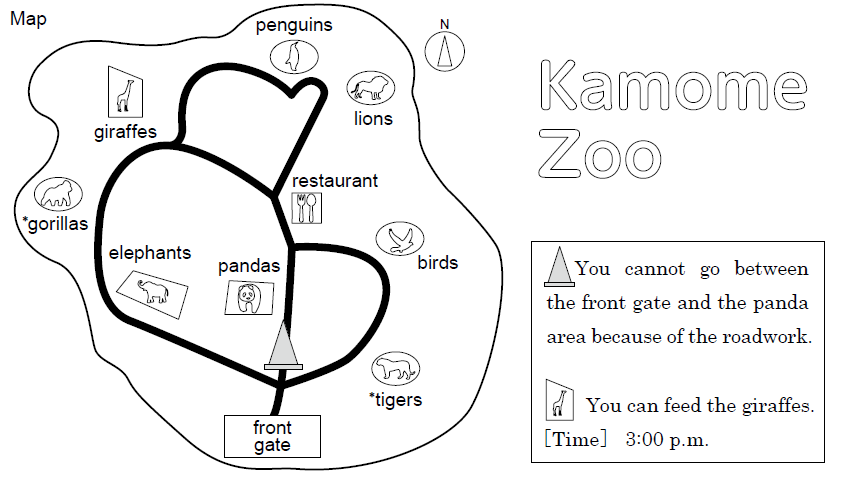
Question :What is the fifth animal area Toru and Rod will visit at the zoo ?
* roadwork:道路工事 feed ~:~に餌をやる giraffes:キリン penguins:ペンギン gorillas:ゴリラ tigers:トラ
Ryoji is a high school student. He reads the article of an event on his city’s website and makes a poster for the event. He is going to put the poster on Kamome Elementary School’s website.
Article
Come to Kamome Beach ! You will have a good time there, and you can save the *earth. Kamome City is going to have an event. It’s called Cleaning Kamome Beach. On Sunday, March 5, 12, 19, and 26, you will pick up the trash on the beach from 1 p.m. to 3 p.m.
Joining this event is easy. You don’t have to bring anything like trash bags or gloves. You can just come to the event, and you will find everything you need there. During the event, you can join the Trash Picking Contest each day. The person who picks up the most trash
wins the contest and gets a special ticket from the Kamome Shopping Mall. With that ticket, you can take singing lessons, Spanish lessons,
or swimming lessons at the mall. There are other good points. If you take part in Cleaning Kamome Beach with someone or with more than one person, each person can get a T-shirt. It is designed for this event, and it is made from *recycled plastic. Finally, people who come to this event every Sunday in March can get a special ticket. You can eat
“Today’s Breakfast” at the Kamome Beach Restaurant with that ticket. Let’s save the earth at Kamome Beach !
* earth:地球 recycled:再生された
Poster
Cleaning Kamome Beach
~ Pick up the trash, and let’s save the earth. ~
Time: 1 p.m. to 3 p.m.
Date: Every Sunday in March
From March 5
Place: Kamome Beach
Just come to the beach !
Things to use for cleaning are[ ① ]at the beach.
There are nice presents !
・ Win the Trash Picking Contest and enjoy learning singing, Spanish, or swimming at the Kamome Shopping Mall.
・ Join this event as a group and [ ② ] .
・ If you join this event [ ③ ], you can enjoy “Today’s Breakfast” at the Kamome Beach Restaurant.
Question:What will be in [ ① ] , [ ② ] , and [ ③ ]?
1. ① ready ② receive special clothes ③ for the earth
2. ① useful ② get a special ticket ③ all Sundays in March
3. ① ready ② receive special clothes ③ all Sundays in March
4. ① useful ② get a special ticket ③ for the earth
5. ① useful ② receive special clothes ③ all Sundays in March
(ア) 5
問題 → ToruとRodが5番目に見る予定の動物は?
以下本文和訳
Toru : この地図を見ると、どの場所でどんな動物が見られるかがわかるね。
Rod :この動物園ではたくさんの動物が見られるね!
Toru : 最初にどこへ行きたい?
Rod :今、正門にいるね。まずゾウのエリアに行くのはどう?
Toru : それもいいけど、こっちの道を通るのはどうかな?もう11時だから、そろそろお腹がすきそうだよ。レストランへ一番早く行ける道を通ろう。
Rod :そうだね。その途中でパンダも見られるし。
Toru : あ、この地図によると、その道は工事中で通れないみたい。
Rod :OK。じゃあ、別の道を通って行こう。途中で動物たちも見られるしね。パンダは昼ごはんのあとに見よう。
Toru : いいね!パンダのあとには何を見ようか?
Rod :地図によると、キリンにえさをあげることができるみたい!やってみよう!
Toru : それはおもしろそう!でも、えさやりは3時から始まるんだ。だから今すぐ行くのはちょっと早いね。先にライオンを見て、そのあとペンギンを見よう。
Rod :完璧だね!とても楽しみだよ。それから、帰る前にゾウも見るのを忘れないようにしよう。
Toru : OK!行こう!
太字部分が解答の判断材料となる。
(イ) 3
以下本文和訳
かもめビーチに来てください!そこでは楽しい時間を過ごすことができ、地球を守ることもできます。かもめ市ではイベントが行われます。それは「かもめビーチクリーン」と呼ばれています。3月5日、12日、19日、26日の日曜日に、午後1時から3時までビーチのごみを拾います。このイベントへの参加は簡単です。ごみ袋や手袋のようなものを持ってくる必要はありません。イベントに来るだけで大丈夫です。必要なものはすべてその場にあります。イベント中には、毎回「ごみ拾いコンテスト」に参加できます。最も多くのごみを拾った人がコンテストに勝ち、かもめショッピングモールから特別チケットをもらえます。そのチケットを使うと、モールで歌のレッスン、スペイン語のレッスン、または水泳のレッスンを受けることができます。他にも良い点があります。誰かと、または複数人で「かもめビーチクリーン」に参加すると、参加者一人ひとりがTシャツをもらえます。そのTシャツはこのイベントのためにデザインされ、リサイクルプラスチックで作られています。最後に、3月の毎週日曜日にこのイベントに来た人は、特別チケットをもらうことができます。そのチケットで、かもめビーチレストランの「今日の朝食」を食べることができます。かもめビーチで地球を守りましょう!
太字部分が解答の判断材料となる。
Aoi, Kyoko, and Jiro are Kamome High School students. One day, they are talking in the classroom after school. Then, Ms. White, their English teacher, talks to them.
Ms. White: Hi, Aoi, Kyoko, and Jiro. What are you doing ?
Aoi : We are talking about a *discussion event *on *political issues. We will join the event in the *city office next week. Students from three high schools in our city and some foreign students visiting our city will talk about *voting.
Ms. White: Very interesting !
Kyoko: I am excited to talk with students from other countries. Ms. White, I have a *graph here. Researchers asked young people in four countries, “How much are you interested in political issues ?” In ①Graph 1, we can say that about 70% of young people in *Germany were interested or very interested in political issues. The *rate of young people in Japan who were not so interested or not interested was almost 50%. I think that’s a problem.
Jiro: Young people don’t *vote because they are not interested in political issues. In some countries, people must *pay a fine if they don’t vote.
Ms. White: Great job, Jiro ! Did you learn anything else ?
Jiro: Yes. I found this interesting graph when I did my homework given from the city office. ②Graph 2 shows the voting rate in the national *elections from 2010 to 2022 in Japan. The voting rate of people *in their sixties was always above 60%. However, the rate of *teenagers never reached 50%. Now I really think voting is an interesting topic.
Ms. White: Aoi, for the discussion, what question are you going to ask ?
Aoi : It’s “What should the *government do to raise the voting rate of young people ?”
Ms. White: What are your ideas, Aoi ?
Aoi : I think our government should use more money for young people. If an election topic is how to use government money for them, more young people will vote for their own future.
Ms. White: That’s an amazing idea. Please enjoy the discussion, everyone.
About a week later after the discussion event, Aoi, Kyoko, and Jiro talk to Ms. White.
Jiro: Hello, Ms. White. The discussion event was great ! Do you have time to talk ?
Ms. White: Sure. You talked about the things the government should do, right ? Have you found an answer ?
Jiro: Yes. I asked one student from Australia about paying a fine when people didn’t vote in Australia. He said that was not the right message the government should send. At first, I thought paying a fine was a good idea, but now I don’t think so. Instead, the government should make voting fun. I think the government should create a new holiday on an election day and have a festival near the voting places.
Kyoko: I said the government should listen to young people’s opinions. The government should have meetings with young people before deciding what actions to take.
Aoi : I think that the government should help young people learn about political issues because young people don’t know how the system works. Our school had a *mock election last year, and I learned a lot. I think the government should tell all high schools in Japan to have mock elections.
Ms. White: Did anyone help your discussion ?
Aoi : Yes. A *social studies teacher from the U.S. asked us many questions that helped us continue the discussion. For example, she asked Jiro why paying a fine wasn’t as good as other ideas. We learned how to have a good discussion from her. Now, Ms. White, [ ], and we need to decide when to have it. We’ll do that because we hope that other students will be more interested in political issues.
Ms. White: That’s a great idea, Aoi. Kyoko, will you also tell us what kind of experience you had from the discussion ?
Kyoko: I really enjoyed listening to other people’s unique opinions and reasons. Each opinion and each reason was different. How about you, Jiro ?
Jiro: I enjoyed talking to other people about my opinions and reasons. It helped me understand my own ideas well.
Ms. White: I’m glad that you had a great experience !
* discussion:議論 on ~:~について political issues:政治的な問題 city office:市役所 voting:投票 graph:グラフ Germany:ドイツ rate:割合 vote:投票する pay a fine:罰金を払う elections:選挙 in their sixties:60 歳代の teenagers:10 歳代の人 government:政府 mock:模擬 social studies:社会科
(ア) 本文中の①Graph 1と②Graph 2が表す内容を,①はア群,②はイ群の中からそれぞれ選んだときの組み合わせとして最も適するものを,あとの1 ~ 9 の中から一つ選び,その番号を答えなさい。
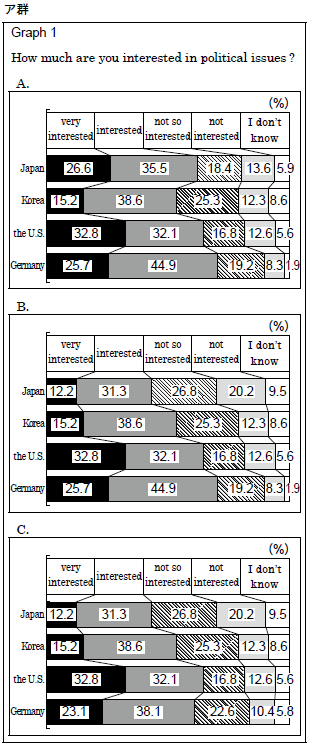
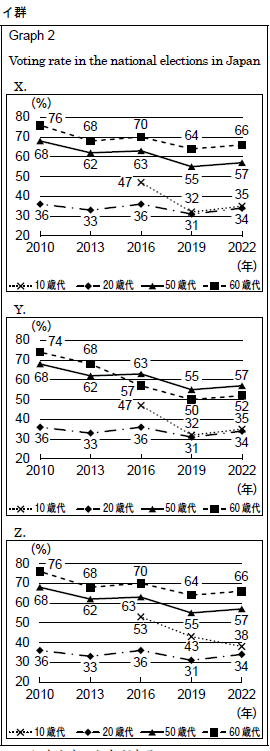
1.①:A ②:X 2.①:A ②:Y 3.①:A ②:Z
4.①:B ②:X 5.①:B ②:Y 6.①:B ②:Z
7.①:C ②:X 8.①:C ②:Y 9.①:C ②:Z
(イ) 本文中の[ ]の中に入れるのに最も適するものを,次の1 ~ 4 の中から一つ選び,その番号を答えなさい。
young people can actually find an answer if they have a little help
young people had a good discussion on voting and paying a fine with some help
we’re planning to have a discussion event on political issues at our school
we had a good discussion on political issues with other students at our school
(ウ) 次のa ~ f の中から,本文の内容に合うものを二つ選んだときの組み合わせとして最も適するものを,あとの1 ~ 8 の中から一つ選び,その番号を答えなさい。
a . Jiro found interesting information in his homework for the discussion and became interested in the topic of voting.
b . By doing her homework for the discussion, Aoi learned that the Japanese government used enough money for young people.
c . During the discussion, Jiro’s opinion changed the opinion of the student from Australia about paying a fine.
d . Kyoko said that all high schools in Japan should have mock elections, and Aoi said that the government should have meetings with young people.
e . After the discussion event, Kyoko said that everyone had opinions and reasons that were not the same.
f . After the discussion event, Jiro said that he couldn’t understand his own ideas well by talking with other people.
1. aとc
2. aとe
3. bとd
4. bとe
5. cとd
6. cとf
7. dとe
8. eとf
(ア) 4
どちらもグラフの紹介があった後すぐにそのグラフの説明にはいっているので、そこから判断する。
①Graph 1: we can say that about 70% of young people in *Germany were interested or very interested in political issues. The *rate of young people in Japan who were not so interested or not interested was almost 50%.(ドイツの若者のおよそ70%が、政治的な問題に「関心がある」または「とても関心がある」と言えるでしょう。一方、日本の若者で「それほど関心がない」または「関心がない」と答えた人の割合は、ほぼ50%でした。)ここから、ドイツの割合が70%に達していないC,日本の割合が50%に達していないAは正しくない。
①Graph 2: Graph 2 shows the voting rate in the national *elections from 2010 to 2022 in Japan. The voting rate of people *in their sixties was always above 60%. However, the rate of *teenagers never reached 50%. (グラフ2は、2010年から2022年までの日本の国政選挙における投票率を示しています。60代の人々の投票率は常に60%を超えていました。しかし、10代の投票率は一度も50%に達しませんでした。)ここから、60代の投票率が60%を下回っているY、10代の投票率が50%を超えているZは正しくない。
(イ) 3
本文中[ ]の後に注目する。文章は[ ],and we need to decide when to have it. We’ll do that because we hope that other students will be more interested in political issues. Ms. White: That’s a great idea, Aoi. …と続く。「and we need to decide when to have it.」は(そして、私たちはそれをいつ行うかを決める必要があります。)という意味。つまり[ ]内では何かを行おうとしている文章が来るのが文脈的に自然である。
そう考えて選択肢を見ると3が適切であるとわかる。
(ウ) 2
本文中の「 Jiro: Yes. I found this interesting graph when I did my homework given from the city office. ~Now I really think voting is an interesting topic.」、「Kyoko: I really enjoyed listening to other people’s unique opinions and reasons. Each opinion and each reason was different. How about you, Jiro ?」がそれぞれ選択肢のaとeの内容に合致する。
家庭教師のやる気アシストは、神奈川県にお住まいの受験生のお子さんを毎年たくさん指導をさせ頂き、合格に導いています。
高い合格率の秘訣は、指導経験豊富な先生の指導力に加え、1対1の指導でお子さん一人ひとりの状況に合わせた、お子さんだけのカリキュラムで勉強が進められるから!
家庭教師のやる気アシストは、お子さんの志望校合格まで全力でサポートさせて頂きます!
LINE問合せ窓口
LINEからもお問合せいただけます!
公式Instagram
勉強のお役立ち情報を配信中!
お問い合わせ、ご質問も受付中です!
ご質問などお気軽にお問い合わせください。
お子さんにとって「成果が出る勉強法」ってどんな勉強法だと思いますか?
お子さんそれぞれに、個性や性格、学力の差もあります。そんな十人十色のお子さん全員に合う勉強法ってなかなかないんです。
たからこそ、受験生の今だけでもお子さんだけの勉強法で受験を乗り越えてみませんか?
やる気アシストには、決まったカリキュラムはありません。お子さんの希望や学力、得意や不得意に合わせて、お子さんだけのカリキュラムで指導を行っていきます。また、勉強法もお子さんそれぞれに合う合わないがあります。無料体験授業では、お子さんの性格や生活スタイルを見せていただき、お子さんにとって効率的な成果の出る勉強のやり方をご提案させて頂きます。