

東京都の2026年3月実施の令和8年度(2026年度)入学者の公立高校入試問題の解説をしています。
受験勉強において、過去問を解くことはとても効果的な勉強法です。ぜひ、受験までに一度挑戦し、問題の傾向を掴んでおきましょう。合わせて、対策などをたてられるととても良いですね。
また、過去問で苦手な点が見つかった場合は、そこを中心に試験日当日までにしっかりと対策しておきましょう。
東京都の公立高校入試情報はこちら
東京都で家庭教師を考えている方はこちら
次のア~エの中から適するものをそれぞれ一つずつ選びなさい。
<対話文 1 >
【放送文面】
Becky: Hi, Jim. I started learning Japanese last month.
Jim: Thatʼs nice, Becky. Do you take lessons at school?
Becky: Yes, itʼs interesting. I also study at home. I often use a dictionary.
Jim: I see. Do you use anything else?
Becky: Yes. I read picture books every day. They help me understand Japanese. That
is the best way for me to learn it.
Jim: Thatʼs good. I want to learn Japanese, too. What should I do first?
Becky: Taking lessons is good. If you like movies, you should watch Japanese movies.
Jim: Oh, thatʼs nice.
Question : What is the best way for Becky to learn Japanese?
【選択肢】
ア Using a dictionary.
イ Reading picture books.
ウ Taking lessons.
エ Watching Japanese movies.
<対話文 2 >
【放送文面】
Yumi: Hi, John. Did you finish the math homework from Ms. Tanaka?
John: No, Yumi. Some questions in the homework are very difficult, right?
Yumi: Yes. So Iʼm going to go to the teachersʼ room to ask Ms. Tanaka.
John: Thatʼs good. But she is talking with Kota and Shun in their classroom now.
Yumi: Oh, really?
John: Well, how about going to ask one of my classmates, Ayaka? She is good at math.
Yumi: Sounds good. Letʼs ask her to help us.
John: Yes, letʼs
Question : Who will Yumi and John ask to help them?
【選択肢】
ア Ms. Tanaka.
イ Kota.
ウ Shun.
エ Ayaka.
<対話文 3 >
【放送文面】
Mike: Kate, you and my sister are on the same soccer team, right?
Kate: Yes, Mike. Why?
Mike: I want to buy a birthday present for her. What should I buy?
Kate: She said she wanted new soccer shoes.
Mike: My grandfather is going to buy her some new soccer shoes.
Kate: Thatʼs nice. Well, does she have a new soccer ball?
Mike: No, but she has some soccer balls.
Kate: How about buying a Great Rabbitsʼ T-shirt? Great Rabbits is a very popular
soccer team.
Mike: Oh, she often wears a Great Rabbitsʼ cap. I like your idea. Iʼll do that.
Question : What will Mike buy for his sister as a birthday present?
【選択肢】
ア New soccer shoes.
イ A soccer ball.
ウ A Great Rabbitsʼ T-shirt.
エ A Great Rabbitsʼ cap.
<Question1 > では,下のア~エの中から適するものを一つ選びなさい。
<Question2 > では,質問に対する答えを英語で書きなさい。
【放送文面】
これから聞く英語は,外国人の Helen 先生が7月のある日に中学校の授業で行ったスピーチです。内容に注意して聞きなさい。
あとから,英語による質問が二つ出題されます。< Question 1 >では,質問に対する答えを選んで,その記号を答えなさい。< Question 2 >では,質問に対する答えを英語で書きなさい。
なお,< Question 2 >のあとに,15 秒程度,答えを書く時間があります。
では,始めます。
Hello, everyone. I enjoy my life in this school. I have worked here for two months.
Today, Iʼll talk about my favorite things about this school.
First, everyone is friendly. Many students always say “Hello” to me. And I have
been doing English club activities for a month. The members there try to communicate
with me in English.
Second, the view from the fourth floor is beautiful. Some students told me that I
could see a beautiful view of the mountains from there. I have lived in Japan for ten
months, and I have seen many nice views. The view from this school is the best of all.
Third, students in this school work hard in many activities. I talked about music
with students yesterday. Some of them have practiced singing together for three
months. Theyʼre going to sing songs at the town theater next month. Iʼm going to go
there to listen to the songs.
This school is special for me. Thank you.
< Question 1 > How long has Helen worked at the school?
< Question 2 > Why is Helen going to go to the town theater next month?
【選択肢】
ア For two months.
イ For a month.
ウ For ten months.
エ For three months.
<対話文 1 >イ
ベッキーにとって、日本語を学ぶ一番の方法は?と聞かれているので
Beckyの「Yes. I read picture books every day. They help me understand Japanese. That
is the best way for me to learn it.」
というセリフからイが答えです。
<対話文 2 >エ
ユミとジョンが助けを求めに行くのは誰ですか?と聞かれているので
「Well, how about going to ask one of my classmates, Ayaka?」
というセリフからエが答えです。
<対話文 3 >ウ
マイクは姉(妹)への誕生日プレゼントに何を買うつもりですか?
少し難しいです。ケイトの「How about buying a Great Rabbitsʼ T-shirt?」が答えになります。
マイクの「Oh, she often wears a Great Rabbitsʼ cap.」からエとしないように注意しましょう。
< Question 1 >ア
ヘレン先生はどのくらい学校で働いているの?と聞かれているので
I have worked (here=school) for two months.
が正解となります。
< Question 2 >(例)To listen to the songs.
Iʼm going to go there to listen to the songs.
という部分を参照して、歌を聞くためと出来ていれば正解です。
次の各問に答えよ。
高校生の Ryota とカナダからの留学生の Paul は,二人のクラスメイトの Sayuri が行った調査について話をしている。 A 及び B の中に,それぞれ入る単語・語句の組み合わせとして正しいものは,下のア~エのうちではどれか。ただし,下のⅠは, Sayuri が行った調査の結果である。
Ryota: Have you answered the question which Sayuri made?
Paul: Of course.That is the question which asked us to pick one answer
from six choices, right?
Ryota:Yes.She said that she was going to do a homestay in the U.K. this summer. Our teacher asked us to help her.
Paul: Sayuri said that we can see the results for the question on our computers.Letʼs
look at them together.
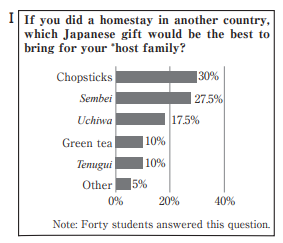
Ryota:Yes, letʼs. Well…,I answered 【A】.I thought that it would be the most popular gift of all.
Paul: I thought so, too.But it is next to the most popular gift in the survey.
Ryota:Did you choose the same answer as I did?
Paul: No.Actually,I chose 【B】 .They are traditional and can be used every day.
Ryota:Thatʼs true.I have heard they are popular in many countries because they are beautiful and will get dry quickly.
Paul:Ten percent of students chose the answer I did.
Ryota:Thatʼs right.I want to do a homestay like you and Sayuri, too.Iʼm interested in other cultures.
〔注〕 choice 選択肢 homestay ホームステイ survey 調査 percent パーセント host family ホストファミリー
ア A Chopsticks B Green tea イ A Sembei B Green tea
ウ A Chopsticks B Tenugui エ A Sembei B Tenugui
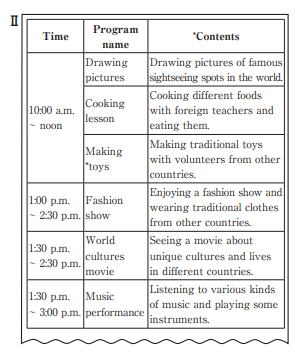
Ryota と Paul は,国際交流イベントについてのウェブサイトを見ながら話をしている。(A) 及び (B) の中に,それぞれ入る語句の組み合わせとして正しいものは,右のページのア~エのうちではどれか。ただし,右のページの II は,二人が見ているウェブサイトの一部である。
Ryota: I found some information about programs in an *international exchange event at Tokyo Kita Hall. It will be held this Sunday.
Paul: That sounds nice. Let’s go to the event.
Ryota: Yes. I’m interested in it.
Paul: I have a piano lesson at three thirty that day. So, I can stay at the event until two thirty.
Ryota: OK, no problem.
Paul: Well, what program from ten a.m. looks good?
Ryota: (A) looks interesting to me.
Paul: Why?
Ryota: It sounds interesting to make something, and I would like to try that.
Paul: That’s nice. We can enjoy foods from other countries in that program.
Ryota: What shall we do in the afternoon?
Paul: These programs all look good.
Ryota: Yes. In my opinion, trying something by myself is more interesting than watching.
Paul: I agree with you. I think we should choose (B) .
Ryota: We can stay until the end of that program. I’m looking forward to the event.
〔注〕 international exchange event 国際交流イベント content 内容 toy おもちゃ
ア (A) Drawing pictures (B) Fashion show
イ (A) Cooking lesson (B) Fashion show
ウ (A) Drawing pictures (B) Music performance
エ (A) Cooking lesson (B) Music performance
次の文章は,カナダに帰国した Paul が Ryota に送った Eメールの内容である。
Dear Ryota,
Thank you for everything while I was in Japan. My best experience was visiting the international exchange event. Through my stay in Japan, I realized that learning about different cultures is very interesting.
I saw a poster about a Japanese calligraphy class at a local center in my country last month. I like looking at calligraphy works in books. I would like to write kanji well. So, I decided to take the class. Two weeks later, I tried Japanese calligraphy for the first time in that class. I tried some kanji, but they didn’t look good. Then my calligraphy teacher said to me that I was doing well. He also told me, “You should imagine kanji in your mind before writing.” That advice helped me improve my writing. Now, I follow his advice and practice. I like doing calligraphy better than looking at works. Japanese calligraphy is now my hobby. I hope I can show you my works someday.
I know you enjoy taking pictures as a hobby. Is there something that you are going to start to do as a new hobby? If you are going to do that, please tell me about it. I’m looking forward to hearing from you soon.
Yours,
Paul
(1) この E メールの内容と合っているのは,次のうちではどれか。
ア Paul saw a poster about a Japanese calligraphy class at the international exchange event.
イ Paul heard from Ryota that Paul should imagine kanji in his mind before writing.
ウ Paul hoped that Ryota would see Paul’s Japanese calligraphy works someday.
エ Paul likes looking at works of calligraphy more than doing calligraphy now.
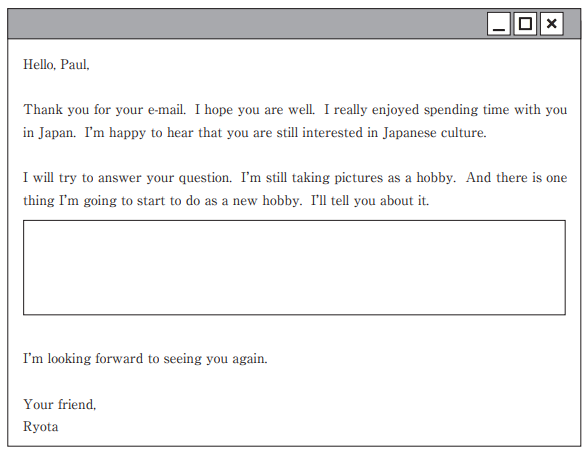
(2) Ryota は Paul に返事の E メールを送ることにしました。あなたが Ryota だとしたら,Paul にどのような返事の E メールを送りますか。次の<条件>に合うように,下の空欄の中に,三つの英語の文を書きなさい。
<条件>
○ 前後の文につながるように書き,全体としてまとまりのある返事の E メールとすること。
○ Paul に伝えたい内容を一つ取り上げ,それを取り上げた理由などを含めること。
Ryotaの「I thought that it would be the most popular gift of all.(一番人気のギフトだと思っていた)」
Paulの「But it is next to the most popular gift in the survey.(けど、調査では次に人気のギフトだったね)」
から(A)はSembeiだと分かります。
また、Paulの「traditional and can be used every day.(伝統的で毎日使える)」
Ryotaの「beautiful and will get dry quickly.(美しくてすぐ乾く)」
から(B)はTenuguiだと分かります。
Paulの「We can enjoy foods from other countries in that program.(このプログラムでは他国の料理の楽しめる)」から(A)はCooking lessonだと分かります。
(B)はRyotaの「trying something by myself is more interesting than watching.(見るよりも何かを体験したいね)」からWorld cultures movieは選択肢から消えます。
さらに文頭のPaul「I can stay at the event until two thirty.(2時半までなら居られる)」と文末のRyota「We can stay until the end of that program.(プログラムの最後まで居られるね)」からFashion showが正解です。
ア:Paulが書道のポスターを見たのは「at a local center in my country」なので不適です。
イ:Paulが聞いたのはRyotaではなく「calligraphy teacher」なので不適です。
エ:Paulは「doing calligraphy」が楽しくなったわけで、「looking at works of calligraphy」ではないので不適です。
LINE問合せ窓口
LINEからもお問合せいただけます!

公式Instagram
勉強のお役立ち情報を配信中!
お問い合わせ、ご質問も受付中です!

ご質問などお気軽にお問い合わせください。
次の対話の文章を読んで,あとの各問に答えよ。
Haruto, Kenta, and Shiho are second-year high school students in Tokyo. Mary is a high school student from Australia. They are members of the *Clean-up Committee this year. One day in April, they are talking in a classroom just before the second meeting of the *committee.
Haruto: At the meeting today, we are going to talk about the activities we will do to reach our main goal for this year. I hope we can have a good discussion about that.
Mary: Yes. We didn’t have school cleaning activities in my school in Australia. I’m looking forward to talking about the activities.
Kenta: Do you remember the main goal of our committee for this year?
Shiho: It’s “making our school a comfortable place.” That sounds *worthwhile.
Kenta: (1) I think so, too. I will work harder for my school than last year.
Shiho: Among us, only you were a member of the committee last year.
Kenta: Yes. Ask me anything if you have any questions about the committee’s activities in our school.
Mary: Sure, I’ll do that. I’m just trying to think of ways to reach our main goal.
Haruto: We can do something to keep our school clean.
Mary: Our school is always clean because of the work of the committee members.
Kenta: (2) I’m happy to hear that from you.
Haruto: The leader of our committee said that *encouraging students to clean their classrooms was one of our activities.
Shiho: The committee members work very hard on that every year.
Haruto: I cleaned my classroom carefully with my classmates last year.
Kenta: And I want to do something new this year.
Mary: What’s that?
Kenta: You know that telling students to *separate trash in the right way is also one of our daily activities.
Haruto: That is important. Many students said that it was difficult to separate trash in the right way.
Kenta: Yesterday, I made this new poster to show how to separate trash. I hope that it will be put on the wall in the entrance hall.
Haruto: Oh, I remember that the Clean-up Committee made a poster last year. Its message was clear and easy to understand.
Shiho: That poster helped students learn how to clean better. Your new poster will also be helpful, Kenta.
Mary: Exactly. Students will learn from it.
Kenta: Thank you.
Mary: Let’s share the idea of Kenta’s poster at the meeting.
Shiho: Yes, let’s do that. And I have another idea. How about putting some flowers in each classroom?
Haruto: What do you mean? We don’t do that as a daily activity of our committee.
Shiho: (3) I think it can be a new way to reach our main goal.
Haruto: That isn’t a clean-up activity.
Kenta: Haruto, you should change your point of view. Shiho, you want to say that “making our school a comfortable place” does not only mean “cleaning up,” right?
Shiho: Yes. Seeing something beautiful helps students feel comfortable.
Haruto: I see.
Kenta: We can get some flowers from the school garden.
Haruto: One of my friends, Takuya, is a member of the *gardening club. I can ask him about that later.
Mary: That sounds nice. (4) Now I think I have another way to reach our main goal, too.
Kenta: What’s that?
Mary: We have a school *lounge, right? We should help students enjoy listening to music there.
Haruto: In the lounge? Tell me more about that.
Mary: We can play relaxing music there. We should collect CDs to do that.
Shiho: Our music teacher will help us. Maybe we can *borrow some CDs from the music room.
Mary: I didn’t think of that. Let’s do that.
Haruto: Yes, let’s. I think Mary’s idea is helpful.
Kenta: I think so, too. But some students want a quiet place. They read books to relax there.
Mary: Oh, I never thought about that.
Shiho: How about playing *classical music? It is often played in cafes to help people relax.
Haruto: That’s true. Let’s talk to the teacher tomorrow.
Kenta: Now I realize that there are many ways to make our daily school life more comfortable. We can do our usual activities and new things, too.
Mary: Yes. Let’s explain our ideas to the other committee members at the meeting. They may give us some advice.
Shiho: We can improve our ideas together.
Haruto: (5) I’m looking forward to doing that.
〔注〕 Clean-up Committee 美化委員会 committee 委員会 worthwhile やりがいのある encourage ~ to … ~に…するように促す separate 分別する gardening club 園芸部 lounge 休憩室 borrow 借りる classical music クラシック音楽
(1) I think so, too. の内容を,次のように書き表すとすれば,_____ の中に,下のどれを入れるのがよいか。
Kenta also thinks that _____.
ア having school cleaning activities in Mary’s school in Australia sounds worthwhile
イ making their school a comfortable place sounds worthwhile
ウ working harder for their school than last year sounds worthwhile
エ having a good discussion about the main goal of the committee sounds worthwhile
(2) I’m happy to hear that from you. の内容を,次のように書き表すとすれば,_____ の中に,下のどれを入れるのがよいか。
Kenta is happy because Mary thinks that _____.
ア their school is always clean because of the work of the committee members
イ she should ask him about the committee’s activities in their school
ウ Haruto cleaned his classroom carefully with his classmates last year
エ the committee should tell students to clean their classrooms every year
(3) I think it can be a new way to reach our main goal. とあるが,このように Shiho が言った理由を最もよく表しているのは,次のうちではどれか。 ア Making a poster helps students learn how to clean better.
イ Sharing the idea of the poster at the meeting will be good.
ウ Seeing something beautiful helps students feel comfortable.
エ Telling students to separate trash in the right way is important.
(4) Now I think I have another way to reach our main goal, too. の内容を最もよく表しているのは,次のうちではどれか。
ア Mary thinks that Shiho can borrow some CDs from the music room.
イ Mary thinks that she can talk to the music teacher about music.
ウ Mary thinks that classical music can help people relax in cafes.
エ Mary thinks that students can listen to some relaxing music in the lounge.
(5) I’m looking forward to doing that. の内容を,次のように書き表すとすれば,_____ の中に,下のどれを入れるのがよいか。
Haruto is looking forward to _____.
ア helping their teacher tomorrow
イ improving their ideas together
ウ doing the usual activities
エ reading books in the school lounge
次の英語の文章を,本文の内容と合うように完成させるとき, (A) 及び (B) の中に,それぞれ入る単語の組み合わせとして正しいものは,下のア〜エのうちではどれか。
At first, Haruto couldn’t understand (A) idea because it wasn’t about a clean-up activity. Then (B) helped Haruto understand the idea.
ア (A) Shiho’s (B) Kenta
イ (A) Shiho’s (B) Takuya
ウ (A) Mary’s (B) Kenta
エ (A) Mary’s (B) Takuya
次の文章は,Haruto た物と話した日に,Mary が書いた日記の一部である。(A) 及び(B) の中に,それぞれ入る単語の組み合わせとして正しいものは,下のア〜エのうちではどれか。
Today, I talked with my friends Haruto, Kenta, and Shiho after school about the activities of the Clean-up Committee. Shiho remembered the main goal of our committee and shared an interesting idea to reach that main goal. I liked her idea very much.
Kenta knew a lot about the (A)activities of our committee. He said he would work harder than last year. He brought a poster showing how to separate trash. Shiho told Kenta that his poster would be (B)to students in our school. I thought so, too.
During the talk, I told my friends about my own idea. They thought it would be(B)and gave me some advice. I was happy about that. I hope my idea will make our (A) school life more comfortable. I’m excited about helping with the activities of our committee this year.
ア (A) new (B) helpful
イ (A) new (B) clear
ウ (A) daily (B) helpful
エ (A) daily (B) clear
指示語問題です。設問の直前に答えが隠れています。
「making our school a comfortable place」に賛同しているのでイが答えです。
こちらの問題も直前に答えが隠れています。
「Our school is always clean because of the work of the committee members.」よりアが正解です。
Kentaの「“making our school a comfortable place” does not only mean “cleaning up,”」
Shihoの「Seeing something beautiful helps students feel comfortable.」よりウが正解です。
Maryの「We have a school *lounge, right? We should help students enjoy listening to music there.」よりエが正解です。
これも指示語問題なので直前に答えが隠れています。
「We can improve our ideas together.」よりイが正解です。
(A)には毎日の、(B)には役に立つという意味の単語がそれぞれ入ります。
次の文章を読んで,あとの各問に答えよ。
Tomomi was a second-year high school student. She was in the Dance Club of her school. She and other Dance Club members often created original dances for music that they liked. When they danced at their high school, many friends came to see them every time. When they danced well and got big *cheers from *audiences, they felt happy.
One day in April, Mr. Matsumoto, the club teacher, said to the members, “I have good news from the town *community center. We have two chances to dance in town festivals. Would you like to dance in the festivals? They will be held in June and July.” Yuko, the leader of the club, said, “Yes. I think we should do that.” Tomomi and the other members agreed and hoped local people would enjoy their dancing.
On the festival day in June, all the members danced *energetically at the community center. Mr. Matsumoto said that he was happy with their dancing. But Tomomi didn’t look *satisfied. Yuko asked Tomomi, “What’s wrong? We all danced very well.” Tomomi said, “I think so, too. But I don’t think that the audience enjoyed our dancing very much.” Yuko said, “I see. Actually, the cheers from the local audience were not so big today. We didn’t dance well enough to get big cheers. Let’s practice more from tomorrow.” The next day, Tomomi and other club members started to practice for the next festival. But Tomomi sometimes remembered the June festival and felt nervous.
One day in June at school, Tomomi asked Mr. Matsumoto, “Will the local audience enjoy our dancing next month? I think that our dancing will be better than last time. But I’m very worried.” Mr. Matsumoto said, “I know that you have been practicing your dancing hard. But you have to become better *performers, too.” Tomomi asked, “Better performers?” Mr. Matsumoto said, “Yes. You should be both dancers and performers. Have you ever done any other performances outside of school?” Tomomi thought for a moment, and she told him about her experience of working for a *kindergarten with some classmates from her junior high school. At that time, they were asked to sing a song by children there. She chose a song that little children would enjoy. She said, “We didn’t sing very well, but the children enjoyed the song and sang together with us.” Mr. Matsumoto said, “That’s wonderful. Why did the children enjoy your song?” She tried to answer his question, but she couldn’t. She thought, “We just sang a song which *seemed to be popular among children.”
At home later on that day, she was watching a music program on TV with her brother, Koji, and her grandfather. Koji was an elementary school student. Then Tomomi heard a song which she liked very much. She said to them, “This song is very popular among students in my school.” Her grandfather said, “Sorry, I don’t know the song. I don’t listen to this kind of music.” Koji said, “Well, I like anime songs. Everyone likes different kinds of songs.” Tomomi said, “Oh, I see….” She thought, “We believed that the audience at the festival would also like songs that we liked. But, actually, maybe they didn’t like them.” She realized that it was important for a performer to think about things which audiences will enjoy. She decided to tell other members about this new point of view.
The next day at the meeting, Tomomi shared this view with other members. The members thought that it was necessary for them to change their way of thinking. Yuko said,”OK. We have one month to prepare something new for the audience that will come to the next festival. Let’s think again about our dance music and ways of dancing.” At first, they talked about the different *generations of local people at the last festival. They were *mainly children, their parents, and their grandparents. The Dance Club members decided to choose songs for older people. They looked for websites and found a lot of lists of old songs that seemed to be popular among older people, such as parents and grandparents. The members created original ways of dancing for those songs. For little children, they created cheerful dances for popular anime songs.
On the festival day in July, all the audiences gave a big cheer for each dance by the members. Many older people sang or danced to songs from their generation. Little children stood up and danced to the anime songs. Everyone at the festival knew that people from different generations were having a good time. They felt especially happy to see that. Yuko said to Tomomi, “I’m very happy that everyone enjoyed our performance.” Tomomi said, “Me, too. Now we are good performers.”
On her way home from the second festival, Tomomi thought about the experiences of the two festivals. She said to herself, “On that day in June, Mr. Matsumoto and my family helped me realize an important thing about performing. I’ll never forget it.” She decided to become a better dancer and a better performer.
〔注〕 cheer 声援 audience 聴衆 community center 公民館 energetically 元気よく satisfied 満足している performer パフォーマンスをする人 kindergarten 幼稚園 seem to ~ 〜のように思える generation 世代 mainly 主に
I think we should do that. の内容を,次のように書き表すとすれば,_____ の中に,下のどれを入れるのがよいか。
I think we should _____.
ア give big cheers to local people in the town festival
イ hear good news from the town community center
ウ dance in the town festivals in June and July
エ have two chances to dance in our school
次のア〜エの文を,本文の内容の流れに沿って並べ,記号で答えよ。
ア Tomomi’s grandfather said that he didn’t know the song Tomomi liked very much.
イ Tomomi and other Dance Club members often created their original dances for music that they liked.
ウ Tomomi couldn’t answer Mr. Matsumoto’s question about her experience at the kindergarten.
エ People from different generations had a good time at the second festival.
次の(1)〜(3)の文を,本文の内容と合うように完成するには,_____ の中に,それぞれ下のどれを入れるのがよいか。
(1) On the festival day in June, _____.
ア Yuko said that the Dance Club members danced very well
イ all the Dance Club members danced energetically, and Tomomi was satisfied
ウ Mr. Matsumoto said that he was happy with the cheers from the Dance Club members
エ the Dance Club members started to practice for the next festival
(2) One day in June at school, _____.
ア children enjoyed Tomomi’s song and sang together
イ Tomomi was very worried about working for a kindergarten
ウ Tomomi’s classmates asked children in a kindergarten to sing a song
エ Mr. Matsumoto asked Tomomi about other performances outside of school
(3) On the second festival day, _____.
ア Yuko said that the Dance Club members were good performers
イ Tomomi decided to become a better dancer and a better performer
ウ all the audiences felt especially happy to get a big cheer
エ many older people got up and danced to anime songs
次の(1),(2)の質問の答えとして適切なものは,それぞれ下のうちではどれか。
(1) What did the Dance Club members do for older people who would come to the second festival?
ア They found lists of songs that seemed to be popular among older people.
イ They created cheerful songs and original ways of dancing for older people.
ウ They talked about the generations of older people who came to their high school.
エ They shared their ways of dancing with older people at the meeting.
(2) What did Tomomi realize from her experiences of the two festivals?
ア She realized that she and the Dance Club members had to practice to be a good audience.
イ She realized that audiences liked songs which were very popular among students in her school.
ウ She realized that it was necessary for local audiences to change their ways of thinking about performers.
エ She realized that it was important for a performer to think about things which audiences will enjoy.
指示語問題なので直前に答えが隠れています。
「Would you like to dance in the festivals? They will be held in June and July.」から答えはウだと分かります。
各選択肢を意訳すると
ア:トモミの祖父はトモミが好きな曲を知らないといった。・・・5段落
イ:トモミと他のダンス部のメンバーは気に入った曲のオリジナルダンスを作っていた。・・・1段落
ウ:トモミは幼稚園での経験についての松本先生の質問に答えられなかった。・・・4段落
エ:二つ目のお祭りで異なる世代の人々が良い時間を過ごしました。・・・7段落
(1)第3段落をまとめます。
(2)第4段落をまとめます。
(3)第7,8段落をまとめます。
(1)第6段落「They looked for websites and found a lot of lists of old songs that seemed to be popular among older people」よりアが正解です。
(2)第8段落「She decided to become a better dancer and a better performer.」よりエが正解です。
LINE問合せ窓口
LINEからもお問合せいただけます!
公式Instagram
勉強のお役立ち情報を配信中!
お問い合わせ、ご質問も受付中です!
ご質問などお気軽にお問い合わせください。
家庭教師のやる気アシストは、東京都にお住まいの受験生のお子さんを毎年たくさん指導をさせ頂き、合格に導いています。
高い合格率の秘訣は、指導経験豊富な先生の指導力に加え、1対1の指導でお子さん一人ひとりの状況に合わせた、お子さんだけのカリキュラムで勉強が進められるから!
家庭教師のやる気アシストは、お子さんの志望校合格まで全力でサポートさせて頂きます!
LINE問合せ窓口
LINEからもお問合せいただけます!
公式Instagram
勉強のお役立ち情報を配信中!
お問い合わせ、ご質問も受付中です!
ご質問などお気軽にお問い合わせください。
お子さんにとって「成果が出る勉強法」ってどんな勉強法だと思いますか?
お子さんそれぞれに、個性や性格、学力の差もあります。そんな十人十色のお子さん全員に合う勉強法ってなかなかないんです。
たからこそ、受験生の今だけでもお子さんだけの勉強法で受験を乗り越えてみませんか?
やる気アシストには、決まったカリキュラムはありません。お子さんの希望や学力、得意や不得意に合わせて、お子さんだけのカリキュラムで指導を行っていきます。また、勉強法もお子さんそれぞれに合う合わないがあります。無料体験授業では、お子さんの性格や生活スタイルを見せていただき、お子さんにとって効率的な成果の出る勉強のやり方をご提案させて頂きます。